The Cartier Santos holds a claim that no other watch in production can match — it is the oldest wristwatch design still being manufactured. In 1904, Brazilian aviator Alberto Santos-Dumont asked his friend Louis Cartier for a watch he could read while keeping both hands on the controls of his aircraft. The pocket watch, the only option at the time, was useless in a cockpit. Cartier’s answer was a flat, square-cased watch with a leather strap that buckled to the wrist. It was practical, elegant, and completely unprecedented.
More than 120 years later, the Santos remains one of the most recognizable timepieces in the world. The square case with exposed screws, the Roman numeral dial, the integrated bracelet — these details have barely changed because they never needed to. Where most sports watches trace their DNA back to the 1950s or 1960s, the Santos predates all of them by half a century.
This guide covers the modern Cartier Santos lineup in detail — current production models, discontinued references, pre-owned pricing, and everything you should check before buying. Whether you’re considering your first Santos or comparing it against other options, this is the information that matters.
The Story Behind the Santos
Paris, 1904. Alberto Santos-Dumont was already famous — a Brazilian heir living in France who spent his fortune building and flying dirigibles over the city. He was a fixture in Parisian society, as well known for his dandyish style as for his aviation feats. Louis Cartier, third-generation head of the Cartier jewelry house, moved in the same circles.
The story goes that Santos-Dumont complained to Cartier about the impracticality of checking a pocket watch while piloting an airship. You needed one hand on the controls and another on the watch — which left no hands for anything else. Cartier designed a small, flat watch with a square case and a leather strap, secured to the wrist with a buckle. Santos-Dumont wore it publicly, and by 1911 Cartier was selling the design commercially.
That makes the Santos the first wristwatch produced for commercial sale. Earlier wristwatches existed — mostly as jewelry pieces for women — but the Santos was the first designed around a functional need and then offered to the public. Every sports watch that followed, from the Submariner to the Royal Oak, owes something to that original commission.
Cartier continued producing variations of the Santos throughout the 20th century, but the modern era began in 2018 when the house relaunched the line as the Santos de Cartier. The redesign kept the original proportions while adding a quick-release bracelet system and updated movements. It was the right call — the new Santos became one of the most talked-about watches of the decade.
The Modern Santos Lineup
Santos de Cartier (Current Production)
The Santos de Cartier is the core of the current collection and the watch most people mean when they say “Santos.” It comes in three sizes — Small (35.1mm), Medium (39.8mm), and Large (47.5mm) — though the Medium is by far the most popular on the pre-owned market. The proportions are slightly rectangular, so the 39.8mm Medium wears more like a 40-41mm round watch.
Case materials span the full Cartier range. Stainless steel is the entry point and the volume seller. Two-tone pairs steel with yellow gold bezel and crown. Full rose gold and yellow gold options sit at the top of the line. ADLC (amorphous diamond-like carbon) versions add a black coating to the bezel for a more contemporary look.
The defining feature of the current Santos is the QuickSwitch system — a spring-loaded mechanism on the underside of the case that lets you swap between the metal bracelet and a leather or rubber strap without any tools. Press the button, slide the bracelet off, click the strap on. It takes about ten seconds. The SmartLink system on the bracelet itself lets you add or remove half-links by hand for micro-adjustment. Both systems work well, and they genuinely change how you wear the watch. A Santos on a bracelet is a sport watch. The same Santos on an alligator strap is a dress watch.
Movements across the current range are automatic — Cartier’s caliber 1847 MC in the Medium and Large sizes, and a smaller automatic caliber in the Small. The 1847 MC is a solid, reliable movement with approximately 40 hours of power reserve. It is not a hand-finished showpiece in the way a Lange or Patek caliber would be, but Cartier has never positioned the Santos as a movement-first watch. The design is the point.
Santos-Dumont
The Santos-Dumont is a separate line that confuses some buyers, so it is worth addressing directly. It shares the square case shape and Roman numeral dial with the Santos de Cartier, but the execution is different. The Santos-Dumont is thinner, lighter, and powered by a manual-wind movement rather than an automatic. It does not have exposed screws on the bezel in the same pattern as the Santos de Cartier, and it lacks the QuickSwitch system.
Think of the Santos-Dumont as the dress watch version — closer in spirit to the original 1904 piece. It sits flatter on the wrist, slips under a cuff more easily, and has a more refined, less sporty feel. It is also significantly less expensive than the Santos de Cartier in equivalent materials, which makes it an attractive entry point for buyers who want a Cartier square-case watch without the sport-watch premium.
On the pre-owned market, Santos-Dumont references tend to hold value well for their price bracket, though they do not command the same demand as the Santos de Cartier Medium in steel.
Santos 100 (Discontinued)
The Santos 100 was Cartier’s answer to the oversized watch trend of the 2000s and 2010s. The standard version measured 41mm, while the XL pushed to 51.1mm — genuinely large by any standard. The “100” in the name referenced the centennial of the original Santos design.
Cartier discontinued the Santos 100 when the Santos de Cartier launched in 2018, and the two watches are quite different in execution. The Santos 100 has chunkier proportions, a more pronounced bezel, and a heavier overall presence. It was the Santos for people who wanted a big, bold watch on their wrist.
Pre-owned Santos 100 references are readily available through dealers like WPB Watch Co, and pricing has come down as the market has shifted toward the more refined proportions of the current Santos de Cartier. That makes the Santos 100 a legitimate value play for buyers who prefer larger watches.
Reference Numbers and Sizes
Cartier reference numbers follow a consistent format, and knowing the key references helps when searching for specific models on the pre-owned market. Here are the most commonly traded Santos references.
| Reference | Model | Size | Case Material | Movement |
|---|---|---|---|---|
| WSSA0018 | Santos de Cartier | Medium (39.8mm) | Stainless Steel | Automatic (Cal. 1847 MC) |
| WSSA0029 | Santos de Cartier | Large (47.5mm) | Stainless Steel | Automatic (Cal. 1847 MC) |
| W2SA0006 | Santos de Cartier | Medium (39.8mm) | Two-Tone (Steel/YG) | Automatic (Cal. 1847 MC) |
| WGSA0011 | Santos de Cartier | Medium (39.8mm) | 18k Rose Gold | Automatic (Cal. 1847 MC) |
| W20073X8 | Santos 100 | Large (41mm) | Stainless Steel | Automatic (Discontinued) |
| WSSA0022 | Santos-Dumont | Large (46.6 x 33.9mm) | Stainless Steel | Manual Wind |
Note that the Santos-Dumont “Large” is measured differently — it is a rectangular case, so the dimensions are given as length by width rather than a single diameter. Despite the “Large” designation, it wears smaller than the Santos de Cartier Medium due to its thinner profile.
What Makes the Santos Different from a Rolex
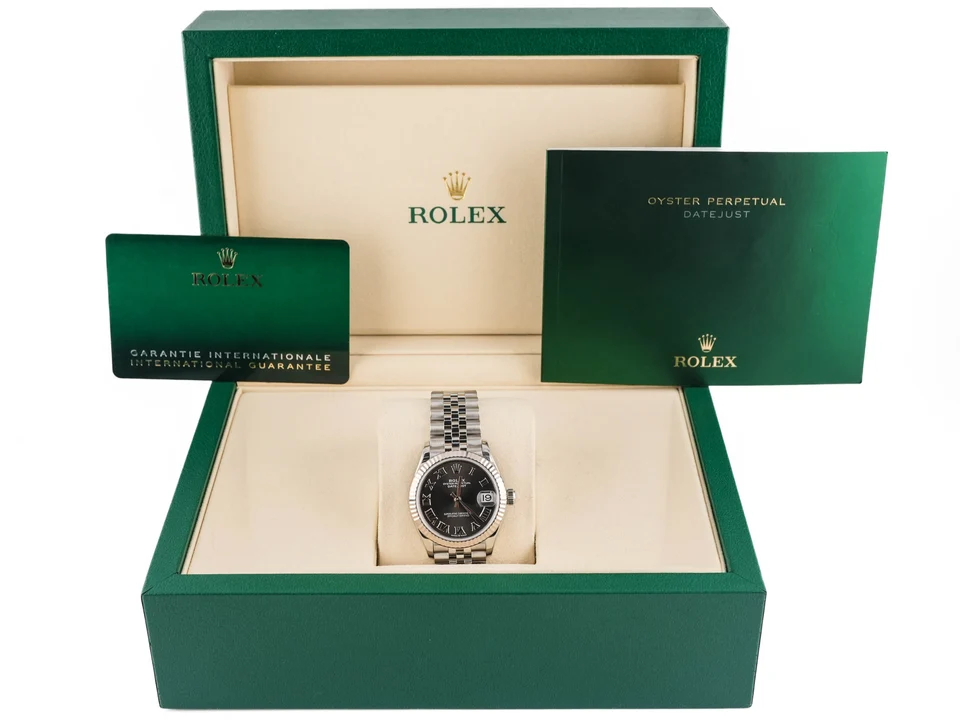
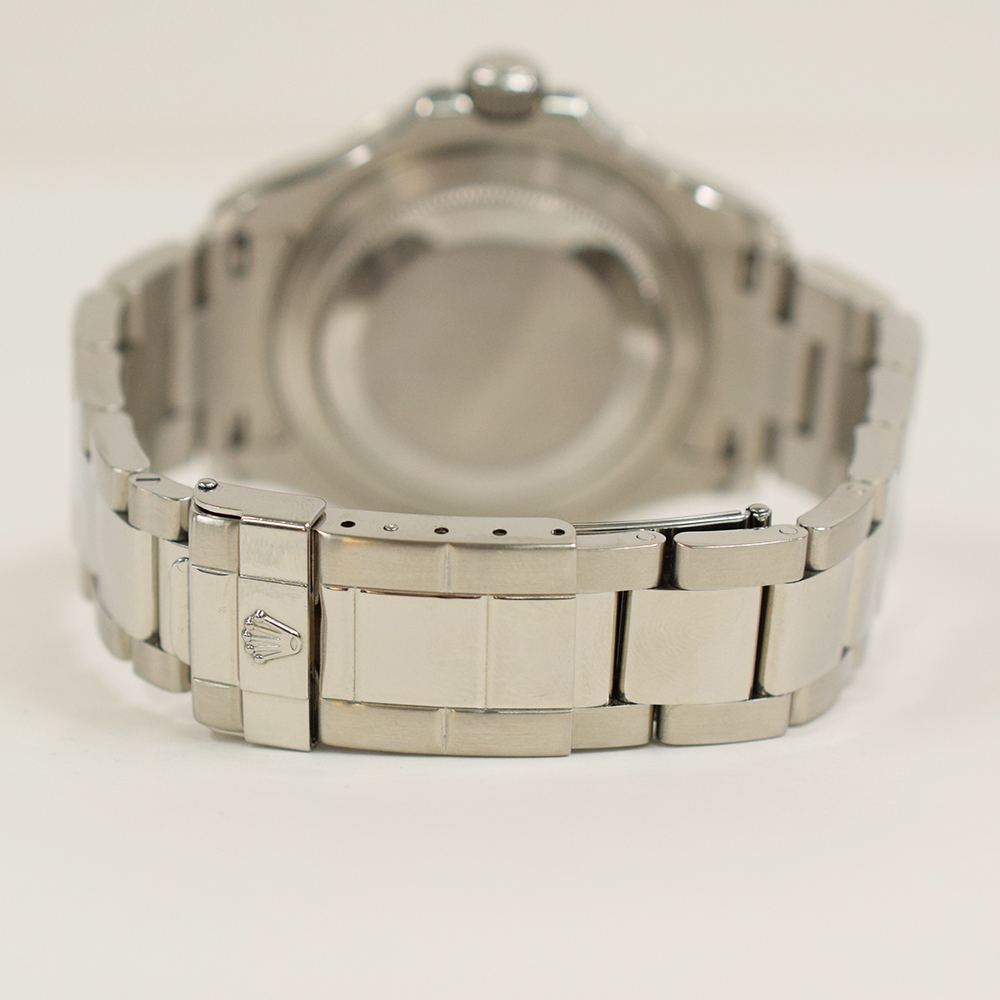
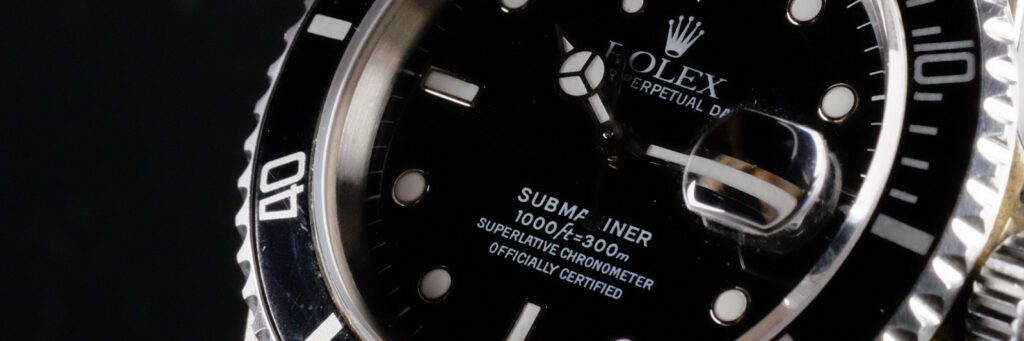
This is the comparison most buyers eventually make, so let’s address it head-on. The Santos and a Rolex Datejust (or Oyster Perpetual, or even a Submariner) are fundamentally different watches from fundamentally different houses.
Cartier is a jewelry maison that makes watches. Rolex is a watchmaker that makes tool instruments. That distinction runs through every design decision. The Santos has a square case, Roman numerals, a blue steel sword hand, and an exposed-screw bezel that references its industrial origins while remaining unmistakably elegant. A Rolex Datejust has a round case, a cyclops lens, and a design language built around legibility and ruggedness.
The Santos wears more like a piece of jewelry on the wrist. It catches light differently because of the flat surfaces and angular case. People notice it in a way they might not notice a round-cased sport watch. That is by design — Cartier builds watches that function as accessories in the broadest sense of the word.
Mechanically, Rolex has the edge. The in-house 1847 MC in the Santos is a capable movement, but Rolex calibers offer superior power reserve, better chronometric performance, and more advanced anti-magnetic properties. If pure horological engineering is your priority, Rolex wins that category.
The QuickSwitch system, however, has no Rolex equivalent. Being able to swap between a bracelet and a strap in seconds without tools is a genuine functional advantage that changes how you wear the watch day to day. Rolex has never offered anything comparable across its lineup.
The honest answer is that these watches serve different buyers. If you want a reliable tool watch with unmatched resale value, buy a Rolex. If you want a design-forward watch with genuine heritage and the kind of visual presence that a round case simply cannot deliver, the Santos belongs on your list.
Pre-Owned Santos Pricing in 2026
The pre-owned Cartier Santos market has stabilized after the broader luxury watch correction of 2023-2024. Prices below reflect typical dealer pricing for watches in good to excellent condition, with box and papers, as of early 2026.
| Model | Approximate Pre-Owned Range |
|---|---|
| Santos de Cartier Medium — Steel | $4,800 – $6,500 |
| Santos de Cartier Large — Steel | $5,500 – $7,500 |
| Santos de Cartier Medium — Two-Tone (Steel/YG) | $7,000 – $10,000 |
| Santos de Cartier Medium — Rose Gold | $12,000 – $16,000 |
| Santos 100 Large — Steel (Discontinued) | $4,000 – $5,500 |
| Santos-Dumont Large — Steel | $3,200 – $4,500 |
Steel Santos de Cartier Medium references represent the sweet spot of the lineup — high enough demand to hold value, low enough price to attract first-time luxury buyers. The discontinued Santos 100 offers the most watch for the money if you prefer larger proportions. Rose gold commands a significant premium but tends to depreciate more slowly in percentage terms because the precious metal provides a floor.
Condition, completeness, and provenance all affect pricing. A Santos with its original box, warranty card, and extra QuickSwitch strap will consistently trade at the top of these ranges. Missing the extra strap alone can knock several hundred dollars off the price, because replacing it through Cartier is not cheap.
Other Cartier Models Worth Knowing
The Santos is Cartier’s most versatile watch, but it is not the only option. If you are exploring the brand for the first time, a few other collections deserve a look.
The Tank Française is the rectangular counterpart to the Santos — a smaller, more refined design with an integrated bracelet and Art Deco proportions. It was relaunched in 2023 with updated sizing and has found a strong audience among buyers who want a Cartier with a more understated presence. The Tank Must offers a similar silhouette at a lower price point, powered by a quartz or solar-charged movement.
The Ballon Bleu is Cartier’s round-cased offering and the house’s best-selling watch globally. It has a distinctive crowned case guard at 3 o’clock and a more fluid, organic design language than the angular Santos. If you know you prefer round watches but still want the Cartier identity, the Ballon Bleu is the natural choice.
The Calibre de Cartier is a sportier round watch that was designed specifically to compete with traditional Swiss sport watches. It has been discontinued in favor of newer references but remains available pre-owned at attractive prices. The Rotonde de Cartier sits at the top of the range — a refined, round-cased collection that houses Cartier’s most complicated movements, including minute repeaters and tourbillons. These are collector-grade pieces with pricing to match.
What to Inspect Before Buying Pre-Owned
Every pre-owned Cartier has its own story, and a careful inspection protects your investment. Here is what to focus on with the Santos specifically.
Crystal condition. The Santos uses sapphire crystal, which is scratch-resistant but not indestructible. Square and rectangular crystals are more prone to edge chipping than round ones because the corners concentrate impact forces. Inspect the edges under good light, especially the corners. A chipped crystal is not cheap to replace through Cartier service.
Crown and cabochon. The Santos crown features a synthetic spinel (on steel models) or sapphire cabochon set into the winding crown. This small gemstone is a Cartier signature and a common point of damage. Check that it is intact, properly seated, and not cracked. A missing or damaged cabochon is an immediate red flag.
Bracelet and QuickSwitch mechanism. Operate the QuickSwitch release several times. The bracelet should detach and reattach with a clean, positive click. On pre-owned examples, dirt or wear can make the mechanism stiff or unreliable. Also check the SmartLink adjustment — each removable link should release and lock smoothly.
ADLC coating. If you are looking at an ADLC-bezel model, examine the coating under strong light. ADLC is durable but it can show wear at the edges, particularly on the corners of the bezel where it meets the case. Worn ADLC cannot be touched up — the entire bezel needs recoating, which is an expensive service procedure.
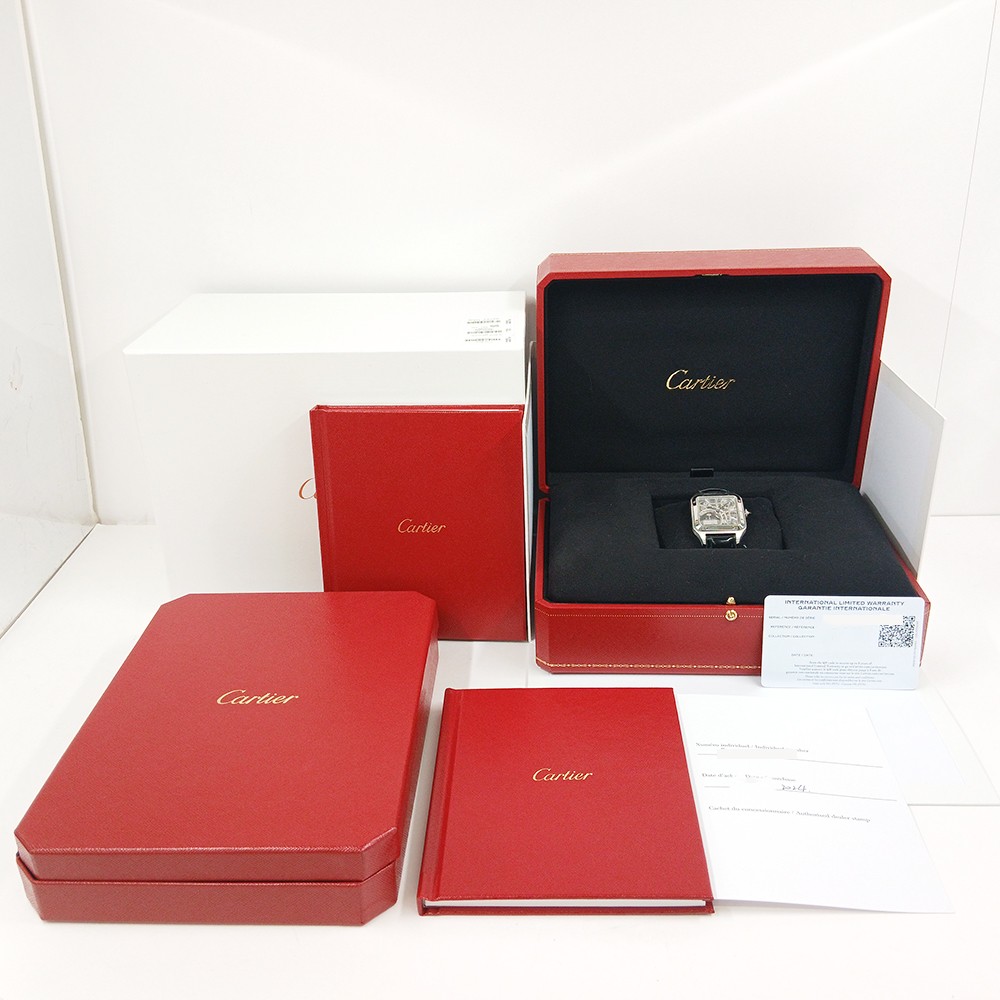
Box, papers, and accessories. A complete set — outer box, inner box, warranty card, instruction booklet, and the extra QuickSwitch strap — adds meaningful value on the pre-owned market. The extra strap is particularly important because the QuickSwitch system is a core feature of the watch. Without the strap, you are buying half the experience.
Why Buy from WPB Watch Co
At WPB Watch Co, every watch in our inventory goes through the same authentication and inspection process — whether it is a Rolex Submariner or a Cartier Santos. We photograph every piece in detail, verify serial numbers and reference codes, and confirm that all components are genuine Cartier parts.
Cartier counterfeits are less common than Rolex fakes, but they do exist, and they have become more sophisticated in recent years. The Santos in particular has seen an uptick in high-quality replicas as the model’s popularity has grown. Buying from an established dealer with a documented authentication process eliminates that risk entirely.
Browse our current Cartier collection online, or contact us if you are looking for a specific reference. We can also source watches on request for clients who know exactly what they want. If you have a watch to sell or trade, we offer competitive pricing with fast turnaround.
You May Also Like
If you are still weighing your options, these guides may help narrow things down. Our women’s luxury watch guide covers the best pre-owned options across brands for women collectors. The first Rolex buying guide walks through the best entry points if you are considering a Rolex instead of — or alongside — a Cartier.
Concerned about authenticity? Our guide on how to spot a fake luxury watch covers the red flags to watch for across all major brands, including Cartier. And if you have a watch you would like to move, visit our sell or trade page for a quote.