Few names in watchmaking carry the weight of Audemars Piguet. Founded in 1875 in the Vallée de Joux village of Le Brassus, Switzerland, AP is one of the “Holy Trinity” of haute horlogerie alongside Patek Philippe and Vacheron Constantin. The company has remained family-owned for nearly 150 years — a rarity in an industry now dominated by conglomerates like LVMH, Richemont, and Swatch Group.
But here is the honest truth about Audemars Piguet in 2026: the brand’s modern identity is defined almost entirely by one watch. The Royal Oak and its descendants account for the overwhelming majority of AP’s sales, cultural relevance, and secondary-market demand. Understanding AP as a collector means understanding the Royal Oak — where it came from, how the family has expanded, and which references hold their value.
This guide covers every major AP family, key references with current pre-owned pricing, what to inspect before you buy, and how the Royal Oak compares to its eternal rival, the Nautilus. This is everything you need to know before buying.
The Watch That Changed Everything
In 1972, Audemars Piguet did something the Swiss watch industry considered suicidal. The company launched a luxury sport watch made entirely of stainless steel — and priced it higher than most gold dress watches of the era. The Royal Oak Ref. 5402ST, quickly nicknamed the “Jumbo,” was designed in a single night by the legendary Gérald Genta, the same man who would later create the Patek Philippe Nautilus in 1976.
Genta’s design drew inspiration from a traditional diving helmet: an octagonal bezel secured by eight visible hexagonal screws, an integrated bracelet that flowed seamlessly from the case, and a textured “tapisserie” dial with a waffle-like pattern that caught light from every angle. At 39mm and just 7mm thick, the Jumbo was remarkably thin for a sport watch, powered by the ultra-slim Jaeger-LeCoultre-based Calibre 2121.
The industry reaction was predictably hostile. A steel watch at gold-watch prices? The trade press called it misguided. Retailers were skeptical. But AP’s gamble paid off. The Royal Oak found an audience among buyers who wanted something bold, unconventional, and unmistakably modern. Within a few years, it had created an entirely new category — the luxury steel sport watch — and fundamentally changed what a high-end timepiece could look like.
More than fifty years later, every major Swiss brand offers some version of a luxury steel sport watch. The Nautilus, the Overseas, the Laureato — all owe their existence to Genta’s overnight sketch. The Royal Oak was not just a product launch. It was an inflection point in horological history.
The Royal Oak Family
The Royal Oak has grown from a single reference into a sprawling family of watches spanning every complication AP makes. Here are the pillars that matter most for collectors.
Royal Oak “Jumbo” (39mm)
The Jumbo is the purist’s Royal Oak. At 39mm with a case thickness of just 8.1mm, it remains the thinnest watch in the Royal Oak lineup and the closest living descendant of Genta’s original Ref. 5402ST. For decades, the Ref. 15202ST carried the Jumbo torch. In 2022, AP replaced it with the Ref. 16202ST, introducing the new in-house Calibre 7121 — an ultra-thin automatic movement with a 70-hour power reserve, replacing the venerable 2121 that had powered the Jumbo since 1972.
The 16202 is the Royal Oak distilled to its essence: time-only, no date window, no complications. The dial options — blue, black, green, salmon — are uniformly stunning. Waitlists at authorized dealers stretch into years, and pre-owned examples of the discontinued 15202 have appreciated significantly since its retirement. If you want to own the most historically significant Royal Oak in production, this is it.
Royal Oak 41mm Self-Winding
The 41mm self-winding Royal Oak is the collection’s workhorse, the model most people picture when they think of an AP. The Ref. 15500ST introduced this size with the Calibre 4302, and the current Ref. 15510ST continues with subtle refinements. It includes a date window at 3 o’clock and offers the broadest range of dial colors and case materials in the Royal Oak family: stainless steel, two-tone steel and gold, and full 18k rose or yellow gold.
For most first-time AP buyers, the 41mm self-winding is the entry point. It is large enough to feel substantial on the wrist without veering into oversized territory, and the Calibre 4302 delivers a solid 70-hour power reserve. Pre-owned steel examples represent the most accessible way to own a current-generation Royal Oak, making this the reference we recommend most frequently to collectors stepping up from Rolex.
Royal Oak Chronograph
The Royal Oak Chronograph adds a timing complication to the classic design, and the Ref. 26331ST with its “panda” dial (silver sub-dials on a dark background) has become one of the most recognizable AP configurations in circulation. At 41mm, it wears identically to the self-winding model but adds two chronograph sub-registers and a tachymeter scale on the inner bezel ring.
Powered by the Calibre 2385, an integrated automatic chronograph movement, the Royal Oak Chronograph is the most complicated Royal Oak that most collectors will ever own. “Integrated” means the chronograph mechanism is built into the base movement rather than bolted on top as a module, a distinction that matters for long-term reliability and service simplicity. Panda-dial 26331 examples are consistently among the strongest performers in AP’s secondary market.
Royal Oak Offshore
When Emmanuel Gueit’s Royal Oak Offshore debuted in 1993, the watch community was not kind. Critics called it “the Beast,” a nickname Gueit embraced. At 42mm with a thicker case, rubber crown guards, and a more aggressive, industrial aesthetic, the Offshore pushed the Royal Oak’s design language far beyond Genta’s original elegance.
The Offshore divided AP collectors then, and it still does. Purists view it as a departure from the Royal Oak’s refined DNA. Others love the wrist presence and the material experimentation: ceramic, forged carbon, titanium, and rubber straps in every color combination imaginable. The Ref. 26470ST is the current steel chronograph, and limited editions with celebrity collaborations (LeBron James, Travis Scott) have made certain Offshore references legitimate collector’s items.
From a buying perspective, the Offshore offers something the standard Royal Oak does not: variety. If you want an AP that is unmistakably bold and available in materials and colors that the mainline Royal Oak will never offer, the Offshore is the answer. Pre-owned pricing can vary wildly depending on the specific reference, material, and whether the piece is from a limited run.
Code 11.59
The Code 11.59 represents AP’s most ambitious attempt to build a second pillar alongside the Royal Oak. Launched in 2019, it arrived to mixed reviews — and “mixed” is being generous. The initial dials, which used a flat lacquer finish, looked underwhelming in photographs and failed to justify the price point. Watch media and collectors were vocal in their disappointment.
AP listened. Subsequent releases with smoked, lacquered, and gradient dials transformed the Code 11.59’s reception. The 41mm case features a complex construction with an octagonal middle case sandwiched between two round elements — a shape that is more nuanced and challenging to produce than it appears. The Calibre 4401, an integrated chronograph movement, is technically excellent and demonstrates AP’s mechanical ambition beyond the Royal Oak.
For the speculative collector, the Code 11.59 is an interesting proposition. If AP succeeds in establishing it as a legitimate second collection — and recent sales suggest they’re making progress — early adopters could benefit from appreciation as the market warms to the line. It is not a sure bet the way the Royal Oak is, but it rewards buyers who trust AP’s long game.

Key References and Pre-Owned Pricing
The following table covers the most sought-after Audemars Piguet references on the pre-owned market as of early 2026. Prices reflect market conditions at the time of writing and will fluctuate with demand, condition, and completeness of the set.
| Reference | Model | Size | Movement | Pre-Owned Range |
|---|---|---|---|---|
| 15202ST | Royal Oak “Jumbo” (discontinued) | 39mm | Cal. 2121 | $62,000 – $85,000 |
| 16202ST | Royal Oak “Jumbo” (current) | 39mm | Cal. 7121 | $55,000 – $72,000 |
| 15510ST | Royal Oak Self-Winding | 41mm | Cal. 4302 | $32,000 – $42,000 |
| 15500ST | Royal Oak Self-Winding (prev.) | 41mm | Cal. 4302 | $35,000 – $45,000 |
| 26331ST | Royal Oak Chronograph | 41mm | Cal. 2385 | $38,000 – $52,000 |
| 26470ST | Royal Oak Offshore Chrono | 42mm | Cal. 3126/3840 | $28,000 – $38,000 |
| 26238ST | Royal Oak Chronograph (new) | 41mm | Cal. 4401 | $55,000 – $72,000 |
| 26240ST | Royal Oak Offshore Chrono (new) | 43mm | Cal. 4404 | $35,000 – $48,000 |
| 26396BC | Code 11.59 Chronograph | 41mm | Cal. 4401 | $42,000 – $58,000 |
| 15550ST | Royal Oak Perpetual Calendar | 41mm | Cal. 5134 | $90,000 – $120,000 |
Gold, two-tone, and limited-edition variants will fall outside these ranges. Full sets (box, papers, AP warranty card) consistently command 15–20% premiums over watch-only sales, particularly on discontinued references like the 15202ST.
What to Check Before Buying
Buying a pre-owned Audemars Piguet requires more scrutiny than most watches at this price level. AP counterfeits have become disturbingly sophisticated, and even genuine pieces can carry hidden service needs that cost thousands to address. Here is what to examine before you commit — or better yet, let an experienced dealer handle the verification for you.
Serial Number Verification
On older Royal Oak references, the serial number is engraved between the lugs at 6 o’clock. Newer references have moved the serial to the caseback. Confirm the serial matches AP’s records and corresponds to the correct reference, production year, and movement number. Mismatched serials are an immediate disqualifier.
Tapisserie Dial Condition
The Royal Oak’s signature textured dial is one of its most defining visual elements — and one of the hardest to replicate convincingly. On genuine pieces, the tapisserie pattern is stamped with remarkable precision: uniform squares, crisp edges, consistent depth. On older references, examine the dial under magnification. Wear, moisture damage, or sun fading will show in the texture before it appears anywhere else on the watch. A refinished tapisserie dial is extremely difficult to execute well, so any signs of re-stamping or unevenness should raise questions.
Bezel Screw Condition
The eight hexagonal screws on the Royal Oak’s bezel are functional, not decorative — they hold the bezel to the case. On vintage pieces, replacement screws are a red flag. Original screws develop a patina that matches the case and bezel, while replacements will often have a slightly different finish, depth, or head shape. If three screws look pristine and five show decades of wear, someone has been replacing parts.
Bracelet Stretch and Link Condition
The Royal Oak’s integrated bracelet is integral to its design and one of the most expensive components to service or replace. Over time, the links develop play, causing the bracelet to feel loose and rattle. Significant bracelet stretch on an AP is not a minor cosmetic issue. A full bracelet overhaul from AP can run $2,000–4,000, and aftermarket links do not exist for most references. Check for uniform link gaps and listen for rattling when you gently shake the watch.
Service History
AP service is expensive (expect $1,500 to $3,000 or more for a full overhaul, depending on the complication) and notoriously slow, with turnaround times of three to six months at AP’s service centers. A recently serviced AP with documentation adds meaningful value. If the seller has no service history and the watch has not been serviced in five or more years, factor the cost and wait time of a service into your offer.
Box, Papers, and AP Warranty Card
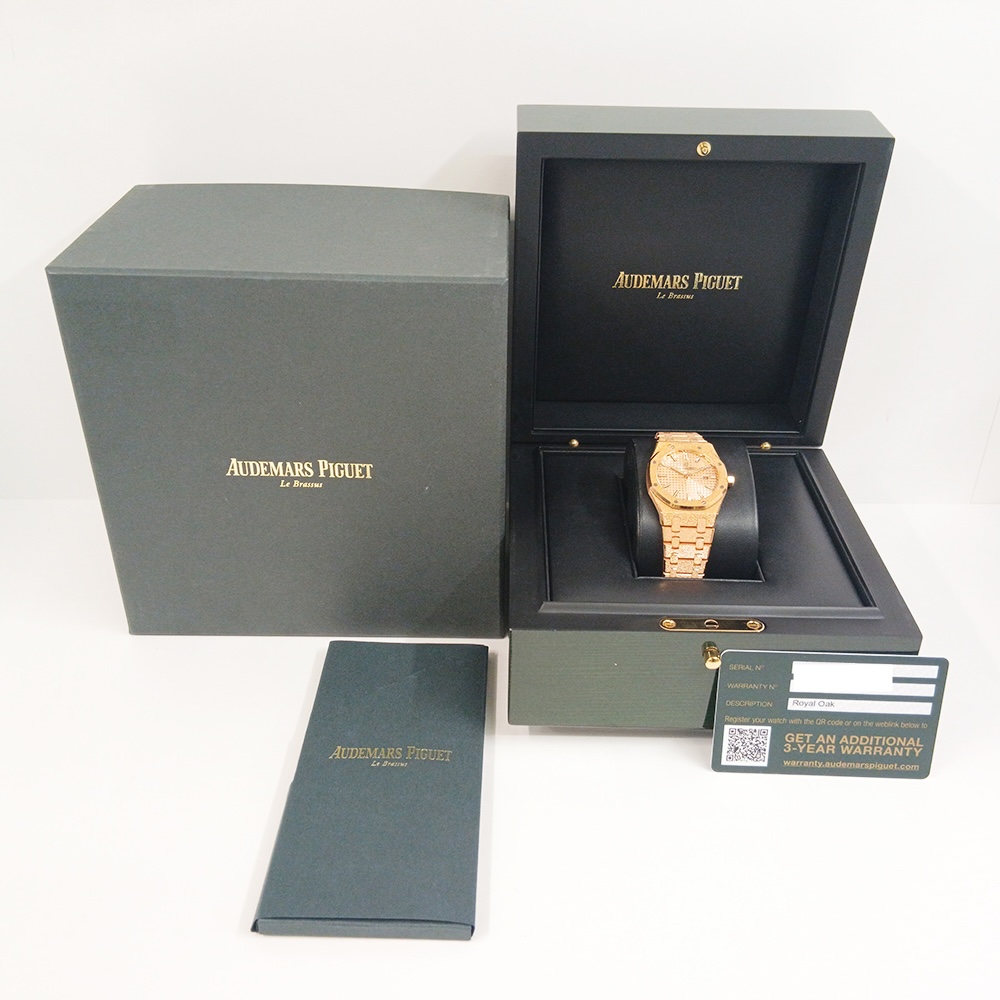
Full sets (original box, instruction manual, hang tag, and especially the AP warranty card with matching serial number) command significant premiums on Royal Oaks. On high-demand references, a complete set can add 15–20% to the price. The AP warranty card in particular is closely tracked by collectors and is one of the most commonly forged accessories in the counterfeit market.
Royal Oak vs. Nautilus
It is the most common question in luxury watch collecting: Royal Oak or Nautilus? Both were designed by Gérald Genta. Both pioneered the luxury steel sport watch category. They feature integrated bracelets, ultra-thin profiles, and movements from two of the greatest manufactures in Switzerland. The Royal Oak came first, debuting in 1972; the Nautilus followed in 1976.
On the secondary market in 2026, the Patek Philippe Nautilus — particularly the Ref. 5711, which was discontinued in 2021 — trades at a significant premium over comparable Royal Oak references. The 5711 discontinuation triggered a speculative frenzy that pushed prices to historically irrational levels. While values have moderated since the 2022 peak, the Nautilus remains the more expensive watch on the secondary market for time-only steel sport references.
That said, the Royal Oak offers something the Nautilus cannot match: range. AP produces the Royal Oak in sizes from 33mm to 44mm and above, in configurations spanning time-only, chronograph, perpetual calendar, tourbillon, skeleton, and concept pieces. The Nautilus family is comparatively narrow. If you want a luxury sport watch with a specific complication or case size, the Royal Oak lineup is far more likely to have exactly what you want.
Both watches hold value exceptionally well. Both are recognizable from across the room. And both represent a meaningful step up from Rolex for collectors ready to enter the world of independent haute horlogerie. The choice ultimately comes down to which design language resonates with you: the Royal Oak’s angular octagonal geometry, or the Nautilus’s softer, porthole-inspired curves.
Why Buy Your AP from WPB Watch Co
Audemars Piguet counterfeits are among the most sophisticated in the watch industry. The Royal Oak’s geometric case and tapisserie dial have been reverse-engineered to an alarming degree of accuracy by counterfeiters, making professional authentication not optional but essential.
At WPB Watch Co, every Audemars Piguet in our inventory undergoes full authentication including serial verification against AP’s production records, movement inspection, dial and case examination under magnification, and bracelet assessment. We are located in West Palm Beach, Florida, and work with collectors across the country who demand certainty when spending five and six figures on a timepiece.
Browse our current AP collection, learn more about our team, or sell or trade your current watch toward an upgrade. If you have a specific reference in mind that is not currently in stock, contact us — we source watches for clients regularly.
You May Also Like
Audemars Piguet vs. Rolex — Royal Oak and Daytona Compared
The Patek Philippe Buying Guide for Pre-Owned Collectors