Every serious watch collector eventually arrives at the same destination: Patek Philippe. While Rolex dominates the conversation in volume and cultural visibility, Patek occupies a different tier entirely. The Geneva-based manufacturer produces roughly 60,000 watches per year compared to Rolex’s estimated one million, and that scarcity is by design. Patek doesn’t chase market share. It pursues perfection, reference by reference, movement by movement.
For the pre-owned buyer, Patek Philippe represents both a pinnacle of craftsmanship and a genuinely compelling financial proposition. Certain references have appreciated more consistently than almost any alternative asset class over the past two decades. Others offer extraordinary value relative to their retail prices, especially on the secondary market where you can skip the multi-year waitlist.
This guide covers the families, references, and practical details that matter when you’re ready to buy. From first-time Patek buyers to seasoned collectors eyeing a Grand Complication, the information here will help you buy with confidence and avoid the mistakes that cost collectors thousands.
What Makes Patek Philippe Different
Patek Philippe is one of the last truly independent watchmakers at the highest level of horology. The Stern family has owned the company since 1932, and that continuity matters. There is no conglomerate board demanding quarterly growth targets, no pressure to dilute the brand with lower-priced lines, and no revolving door of creative directors chasing trends. Every decision at Patek filters through a single question: does this uphold the standard?
In 2009, Patek replaced the Geneva Seal with its own proprietary quality mark, the Patek Philippe Seal. The reason was straightforward: the Geneva Seal wasn’t strict enough. The Patek Philippe Seal governs not just the movement but the entire watch, including the case, dial, and finished product. It requires accuracy within negative three to positive two seconds per day, tighter than COSC chronometer certification. It also mandates specific standards for finishing, water resistance, and reliability that go beyond anything the industry requires.
The finishing on a Patek movement is the kind of thing you need a loupe to fully appreciate. Hand-applied Geneva stripes run in perfectly parallel lines. Edges are beveled at precise 45-degree angles and polished to a mirror finish. Interior surfaces that no owner will ever see receive the same attention as the dial side. This is the difference between watchmaking as manufacturing and watchmaking as an art form.
Perhaps the most remarkable aspect of Patek Philippe is its commitment to every watch it has ever made. The company maintains archives dating back to 1839, and any Patek Philippe watch, regardless of age, can be returned to Geneva for service and restoration. Its advertising slogan, “You never actually own a Patek Philippe. You merely look after it for the next generation,” isn’t just marketing. It’s a service philosophy backed by nearly two centuries of continuity.
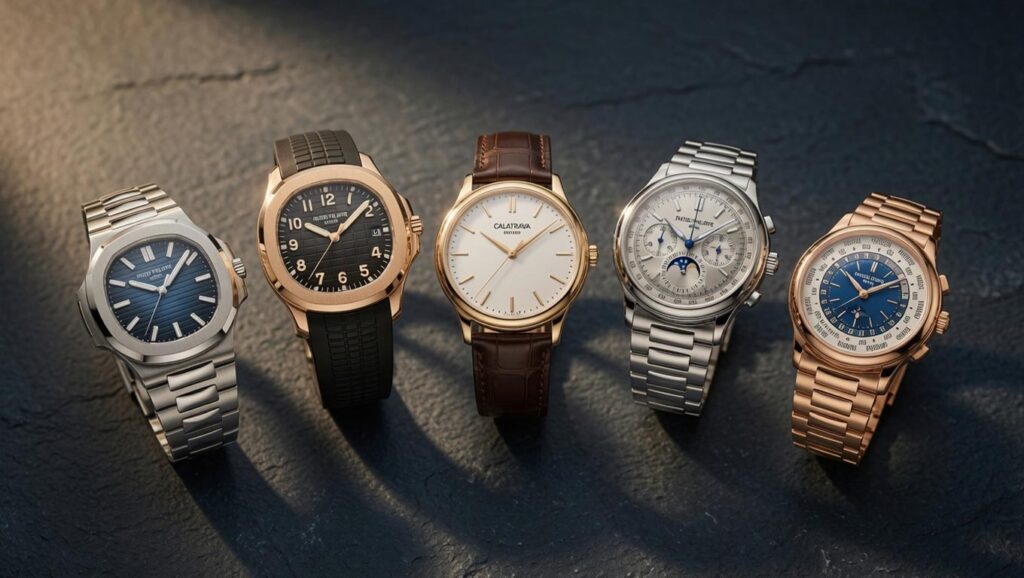
The Four Families Worth Knowing
The Nautilus
The Nautilus is the watch that redefined what a luxury sports watch could be. Designed by the legendary Gérald Genta in 1976, the original Ref. 3700/1A introduced an integrated bracelet and a porthole-inspired octagonal bezel to a market that expected precious metals and leather straps on anything over a certain price point. Reception was initially divided. A luxury watch you could swim in? The idea seemed contradictory. Four decades later, the Nautilus is arguably the single most coveted watch in the world.
The Ref. 5711/1A, with its blue sunburst dial, became the definitive grail watch of the modern era. When Patek discontinued it in January 2021, secondary market prices surged past $150,000 for a watch that retailed around $35,000. Its replacement, the Ref. 5811/1G in white gold with a green dial, carries a retail price that reflects Patek’s decision to move the Nautilus further upmarket. The 5811 features a slightly larger 41mm case and the updated Cal. 26-330 S C movement.
Beyond the flagship time-and-date models, the Nautilus family includes some of Patek’s most desirable complications. The Ref. 5712/1A combines power reserve, date, and moon phase in a single dial that collectors consider one of the best-balanced designs in the lineup. The Ref. 5726/1A adds an annual calendar, requiring just one manual correction per year, in February. The Ref. 5980/1A chronograph brings sporting functionality to the Nautilus platform with the in-house Cal. CH 28-520 flyback movement. Each of these references commands significant premiums on the pre-owned market, and clean examples with full sets are increasingly difficult to source.
The Aquanaut
Launched in 1997, the Aquanaut was Patek Philippe’s answer to a younger generation of collectors who wanted something sportier, more modern, and less tied to the formal traditions of Geneva haute horlogerie. Where the Nautilus nods to industrial design with its flat surfaces and sharp angles, the Aquanaut softens everything into a rounded octagonal case and pairs it with a tropical composite strap that shrugs off sweat, saltwater, and UV exposure.
The Ref. 5167A is the steel entry point into the Aquanaut family and, for many collectors, the most practical Patek Philippe you can buy. At 40mm with a slim profile, it wears comfortably under a shirt cuff or with a t-shirt. The tropical strap makes it genuinely suited for warm climates, and its pre-owned prices remain significantly more accessible than any steel Nautilus.
The Ref. 5164A Travel Time adds a dual time zone complication that’s ideal for frequent travelers. A pusher at 8 o’clock advances the local hour hand independently, making timezone changes effortless. The Ref. 5968A chronograph, introduced in 2019 with a khaki green dial and orange accents, became an instant collector’s piece. It demonstrated that Patek could deliver genuine personality in a sports watch without compromising its finishing standards. Pre-owned 5968A examples have appreciated dramatically, and the watch is widely considered one of the best modern Patek releases of the past decade.
The Calatrava
The Calatrava is the dress watch. It has been since 1932, when the Ref. 96 established the template that every round dress watch has followed since: slim case, clean dial, restrained proportions. If the Nautilus represents what Patek can do with bold design, the Calatrava represents what happens when every unnecessary element is removed and only the essential remains.
The Ref. 5196 is the purist’s choice. Manual winding with a Cal. 215 PS movement, Breguet-style numerals, and a case so thin it virtually disappears on the wrist. There is no date window, no complication, nothing to distract from the dial. It is, in many ways, the most honest expression of Patek Philippe’s philosophy: make a simple watch feel extraordinary.
The Ref. 5296 offers a more contemporary take with self-winding movement and a date display at 3 o’clock, making it the everyday Calatrava for collectors who appreciate the aesthetic but need the practicality of an automatic. Both references are available in rose gold and white gold, with the rose gold models commanding the strongest demand on the secondary market.
Calatravas carry lower premiums than the Nautilus or Aquanaut on the pre-owned market, which makes them arguably the best value proposition in the entire Patek lineup. You get the same movement finishing, the same Patek Philippe Seal, and the same service commitment for a fraction of what the sport models demand. For the buyer who values substance over hype, the Calatrava is the answer.
Complications and Grand Complications
This is where Patek Philippe operates in a class of its own. The Grand Complications collection includes perpetual calendars, world timers, chronographs, minute repeaters, and tourbillons, each representing hundreds or thousands of hours of hand assembly and adjustment.
The Ref. 5327G perpetual calendar tracks the date, day, month, moon phase, and leap year cycle without requiring manual correction until the year 2100. The dial layout is a masterclass in legibility, and the Cal. 324 S Q movement inside is one of the most refined automatic perpetual calendar calibers ever produced. The Ref. 5231 world timer displays all 24 time zones simultaneously on a hand-painted enamel dial, with each piece requiring weeks of work by a single artisan.
The Ref. 5170 chronograph uses the hand-wound Cal. CH 29-535 PS, widely regarded as one of the finest manually wound chronograph movements in production. Minute repeaters and tourbillons occupy the highest reaches of the catalog, with prices starting at six figures and climbing into seven for the most complicated pieces.
Grand Complications are not impulse purchases. They are the watches serious collectors build toward over years, often after owning several Nautilus or Aquanaut references. On the secondary market, well-maintained Grand Complications tend to appreciate over decades, and rare references regularly set auction records. If you’re at this level, you’re not just buying a watch. You’re acquiring a piece of mechanical art.
Key References and Pre-Owned Pricing
The table below reflects approximate pre-owned market pricing as of Q1 2026. Prices vary based on condition, completeness of the set (box, papers, extract), and specific dial variations. All prices represent watches in good to excellent condition with no significant modifications.
| Reference | Model | Case | Movement | Approx. Price Range |
|---|---|---|---|---|
| 5711/1A | Nautilus | SS | Cal. 26-330 | $120,000–$160,000 (disc.) |
| 5811/1G | Nautilus | WG | Cal. 26-330 | $85,000–$110,000 |
| 5712/1A | Nautilus | SS | Cal. 240 PS IRM C LU | $70,000–$95,000 |
| 5726/1A | Nautilus Annual Cal. | SS | Cal. 324 S QA LU | $55,000–$75,000 |
| 5980/1A | Nautilus Chrono | SS | Cal. CH 28-520 | $80,000–$110,000 |
| 5167A | Aquanaut | SS | Cal. 324 S C | $35,000–$50,000 |
| 5168G | Aquanaut | WG | Cal. 324 S C | $45,000–$65,000 |
| 5164A | Aquanaut Travel Time | SS | Cal. 324 S C FUS | $45,000–$60,000 |
| 5968A | Aquanaut Chrono | SS | Cal. CH 28-520 | $90,000–$130,000 |
| 5196R | Calatrava | RG | Cal. 215 PS | $18,000–$25,000 |
| 5296R | Calatrava | RG | Cal. 324 S C | $22,000–$30,000 |
| 5327G | Perpetual Calendar | WG | Cal. 324 S Q | $65,000–$85,000 |
What to Check Before Buying
Buying a pre-owned Patek Philippe is not the same as buying a pre-owned Rolex or Omega. The stakes are higher, the counterfeits are more sophisticated, and the details that determine value are more nuanced. Here’s what to verify before committing.
Serial number verification. Every Patek Philippe has a serial number engraved on the caseback. Patek maintains a comprehensive database of every watch they’ve produced, and your dealer should verify the serial against this database before sale. A mismatch between the serial number and the reference or production year is an immediate red flag.
The extract from the archives. Patek’s extract is a certificate of origin that confirms the watch’s reference, movement number, case material, and original sale date. It’s enormously valuable for resale. A Nautilus without an extract can lose 10 to 20 percent of its market value. If the seller doesn’t have one, you can request it directly from Patek, but the process takes several months and costs approximately $300.
Dial condition. Patek dials are works of art. The sunburst finishing on a Nautilus, the guilloched textures on certain Calatravas, and the applied gold indices across the range are all produced to standards that few other manufacturers match. A refinished dial, even if done competently, destroys originality and significantly impacts resale value. Look for consistent lume aging, crisp printing, and indices that sit perfectly flush.
Bracelet and clasp condition. For Nautilus and Aquanaut models, the original bracelet or strap in good condition is critical to value. The Nautilus bracelet in particular is a hallmark of the design, and replacement bracelets from Patek are expensive, require a service appointment, and can involve wait times measured in months. Check for excessive stretch, deep scratches, or aftermarket links.
Service history. Patek recommends a full service every three to five years. A recent service by Patek Philippe adds confidence and value. Third-party service by a qualified independent watchmaker is perfectly fine for maintaining the watch, but collectors and purists tend to prefer Patek-stamped service records when it comes time to sell.
Box, papers, and accessories. A complete set, including the inner box, outer box, extract, certificate, cork cushion, and travel pouch, can add 15 to 25 percent to the value of a Nautilus or Aquanaut. For Calatravas and complications, the premium for a full set is lower but still meaningful. Always ask the seller for detailed photographs of every accessory.
Nautilus vs. Aquanaut
This is the question that comes up more than almost any other when collectors are considering their first Patek Philippe sport watch. Both share DNA, both hold value, and both deliver the kind of everyday wearability that makes a watch more than just an investment. But they’re meaningfully different, and the right choice depends on what you prioritize.
The Nautilus carries more heritage. It has nearly 50 years of production history, a deeper catalog of references, and the kind of prestige that comes from being the watch that launched the luxury sports category. The integrated steel bracelet is iconic and, for many collectors, defines the wearing experience. On the secondary market, the Nautilus consistently commands higher premiums, and flagship references like the 5711 have become genuine alternative assets, appreciated for both their aesthetic and their financial performance.
The Aquanaut offers a more contemporary design language and a significantly more practical wearing experience in warm climates. The tropical composite strap is lighter, more flexible, and more resistant to sweat and humidity than any metal bracelet. For buyers in South Florida, that’s not a trivial consideration. The Aquanaut also enters at a lower price point, making it more accessible as a first Patek, and its collector base has been growing rapidly.
If your budget allows only one and your primary concern is value retention, the Nautilus is the safer bet. The 5711 is the grail, but even current-production Nautilus references hold their value exceptionally well. If you want a watch you’ll actually wear every day in West Palm Beach, the Aquanaut on its tropical strap is hard to beat. It’s lighter, more comfortable in the heat, and draws just as many knowing glances from the people who understand what they’re looking at.
The honest answer is that most collectors end up owning both. The Aquanaut for daily wear, the Nautilus for occasions that call for a bracelet watch. Start with whichever suits your lifestyle today and add the other when the timing is right.
Why Buy Your Patek Philippe from WPB Watch Co
Authentication is paramount when buying any Patek Philippe, and it becomes even more critical on the pre-owned market. Counterfeit Patek Philippe watches have grown increasingly sophisticated, with super-fakes replicating dial textures, movement decorations, and even hallmarks that fool casual inspection. At WPB Watch Co, every Patek Philippe in our inventory goes through a rigorous multi-point authentication process that includes serial verification against Patek’s database, movement inspection under magnification, and detailed documentation of every component.
We photograph each watch in high resolution from every angle, so you can examine the piece in detail before visiting our showroom. Our pricing reflects real-time market conditions, and we provide full transparency on the condition, provenance, and completeness of every set.
If you’re looking to upgrade your collection, we also offer competitive trade-in values. Trading a Rolex toward your first Nautilus or moving from an Aquanaut to a Grand Complication? Our sell or trade program makes the process straightforward. We handle the appraisal, the paperwork, and the logistics, so you can focus on the watch.
You May Also Like
Patek Philippe Complications and Grand Complications — A deeper dive into perpetual calendars, minute repeaters, and world timers.
Audemars Piguet vs. Rolex — Royal Oak vs. Daytona — How Patek’s main competitors stack up in the luxury sport watch space.
How to Spot a Fake Watch — Authentication tips that apply across all luxury watch brands.
Sell or Trade Your Watch — Ready to upgrade? Get a competitive offer on your current piece.