Table of Contents
A Rolex Yacht-Master is the watch where Rolex first put platinum on a steel sport watch, and that bezel is why the entry price sits above a Submariner at retail. In 2026 a pre-owned 40mm Rolesium ref. 126622 runs about $13,300 to $16,000, while an earlier 116622 can be found from around $12,500.
Go up the range and the numbers climb fast. The Everose Rolesor 126621 trades from roughly $14,600, well under its $19,750 retail. Solid gold on Oysterflex sits in the high twenties to low thirties. The one outlier is the 42mm RLX titanium 226627, which still brings roughly $10,000 over its $16,050 sticker. Everything below is based on pre-owned watches in good to excellent condition, and it covers every Yacht-Master reference worth shopping, plus the relaunched Yacht-Master II.
Rolex Yacht-Master Prices at a Glance
| Reference | Size | Metal | 2026 US Retail | Pre-Owned (Good to Excellent) |
|---|---|---|---|---|
| 16628 | 40mm | 18k yellow gold | Discontinued | High teens to mid twenties |
| 16623 | 40mm | Steel and yellow gold | Discontinued | $10,000–$13,000 |
| 16622 | 40mm | Rolesium | Discontinued | $9,500–$12,500 |
| 116622 | 40mm | Rolesium | Discontinued | $12,500–$16,000 |
| 126622 | 40mm | Rolesium | $13,200 | $13,300–$16,000 |
| 126621 | 40mm | Everose Rolesor | $19,750 | $14,600–$16,500 |
| 126655 | 40mm | 18k Everose, Oysterflex | $37,700 | $28,400–$31,000 |
| 268622 | 37mm | Rolesium | $12,500 | Call for pricing |
| 268621 | 37mm | Everose Rolesor | $17,750 | Call for pricing |
| 268655 | 37mm | 18k Everose, Oysterflex | $32,500 | Call for pricing |
| 226627 | 42mm | RLX titanium | $16,050 | $26,000–$30,500 |
| 226658 | 42mm | 18k yellow gold, Oysterflex | $38,100 | Call for pricing |
| 226659 | 42mm | 18k white gold, Oysterflex | $40,000 | Call for pricing |
| 126680 (YM II) | 44mm | Oystersteel | $20,300 | New for 2026 |
| 126688 (YM II) | 44mm | 18k yellow gold | Roughly $58,000+ | New for 2026 |
These are open-market ranges for pre-owned watches in good to excellent condition. Box and papers, a recent service and an unpolished case move a watch toward the top of its range. A watch with no card, a heavily buffed case or an unknown service history sits at the bottom, sometimes below it. The gold and newer 37mm references change hands rarely enough that we quote them against current inventory rather than print a number that will be stale by next month.
Why the Yacht-Master Costs What It Does
Rolex launched the Yacht-Master in 1992 as a deliberately luxurious sport watch. It sits between the tool-oriented Submariner and the dressy Day-Date, and it has never pretended to be a professional instrument. That positioning explains almost every number in the table above.
The steel models wear a platinum bezel
On every Rolesium reference, the case and bracelet are Oystersteel and the bidirectional bezel is solid 950 platinum, sandblasted to a matte finish with the numerals raised and polished. The numbers stand proud of the surface and catch light at angles a flat ceramic insert never will. You are paying for precious metal on what looks, at a glance, like a steel watch.
It was never built to be a tool
Water resistance is 100 meters, a third of the Submariner. There is no dive-time insert, no chronograph, no second time zone. If you want a Rolex that earns its keep underwater, our Submariner buying guide is the better starting point. The Yacht-Master competes on presence and finishing, which is exactly why it trades below watches with more hype and less metal.
Hype skipped most of the line
During the boom years, the Yacht-Master never had the waitlist heat of the Daytona or the GMT-Master II. The result is a pre-owned market that sits close to retail on Rolesium and well under it on two-tone and gold. The 42mm titanium is the only Yacht-Master that behaves like a hype watch, and its roughly $10,000 premium tells you how different it is from the rest of the family.
What Is the Cheapest Rolex Yacht-Master?
The cheapest way into a Yacht-Master is a pre-owned 16622, the original Rolesium reference built from 1999 to 2012. Clean examples trade around $9,500 to $12,500, which buys you the same platinum bezel concept as the current watch on the older cal. 3135 movement. The two-tone yellow gold 16623 lands in a similar zone at $10,000 to $13,000 if you prefer warmer metal.
At retail, the cheapest new Yacht-Master is the 37mm Rolesium 268622 at $12,500. Among current 40mm references, the 126622 at $13,200 retail is the entry point, and pre-owned examples trade from about $13,300. That tells you the 126622 market has settled at retail rather than above it, so a pre-owned purchase is mostly about getting the watch today without waiting.
The best value in the whole line, in our opinion, is the Everose Rolesor 126621. It retails at $19,750 and pre-owned examples in good to excellent condition trade around $14,600 to $16,500. That is a current-generation two-tone Rolex sport watch with a chocolate dial at thousands under sticker, and very few modern Rolexes offer that math.
What Is Rolesium?
Rolesium is the name Rolex gives to the pairing of Oystersteel with 950 platinum, and for more than two decades it belonged to the Yacht-Master alone. Rolex finally extended it to a Daytona at Watches & Wonders 2026. It debuted in 1999 with the 40mm ref. 16622, a steel watch with a platinum bezel running the cal. 3135. Plenty of dealer copy online credits the 2012 ref. 116622 with inventing Rolesium. It didn’t. The 116622 was the second generation.
Platinum is denser than steel and does not tarnish the way some gold alloys can. On a sandblasted bezel it reads as a soft, cool grey that sits beside the polished steel case without shouting. Most people outside the watch world will never notice it, which is part of the appeal.
Every Yacht-Master Reference and What Changed
| Reference | Years | Size | Movement | Notes |
|---|---|---|---|---|
| 16628 | 1992 onward | 40mm | Cal. 3135 | The original, solid 18k yellow gold |
| 68628 | 1990s | 35mm | Cal. 2135 | Midsize yellow gold, uncommon |
| 16623 | 1990s to 2010s | 40mm | Cal. 3135 | Steel and yellow gold two-tone |
| 16622 | 1999–2012 | 40mm | Cal. 3135 | First Rolesium, steel with platinum bezel |
| 116622 | 2012–2019 | 40mm | Cal. 3135 | Second-gen Rolesium, Maxi dial |
| 126622 | 2019–present | 40mm | Cal. 3235 | Current Rolesium, slate or blue dial |
| 126621 | Current | 40mm | Cal. 3235 | Everose Rolesor, chocolate dial |
| 126655 | Current | 40mm | Cal. 3235 | 18k Everose on Oysterflex |
| 226659 | 2019–present | 42mm | Cal. 3235 | First 42mm, white gold, black Cerachrom bezel |
| 226658 | 2023–present | 42mm | Cal. 3235 | Yellow gold, black Cerachrom bezel |
| 226627 | 2023–present | 42mm | Cal. 3235 | RLX titanium, the premium outlier |
The gold original started it in 1992
The 16628 launched the line as a 40mm watch in solid 18k yellow gold with a gold bidirectional bezel and raised numerals, running the cal. 3135. The weight on the wrist is serious and the look is unapologetic. Our old guide put these at $18,000 to $24,000, but gold has roughly doubled over the last three years and the price of any solid gold Rolex has followed. Today we would describe clean examples as trading in the high teens to mid twenties, with the right dial and full set pushing past that.
The two-tone 16623 made the look accessible, pairing steel with a yellow gold bezel and accents. It remains a solid entry point at $10,000 to $13,000. The 35mm 68628, a midsize yellow gold version on the cal. 2135, is uncommon enough that we price it case by case.
Rolesium arrived in 1999
The 16622 gave the Yacht-Master its identity. Steel case, steel bracelet, platinum bezel. It ran through 2012 and is now the most affordable way into the family. Condition varies widely because these watches are old enough to have been polished and serviced several times, so the spread between a tired example and a sharp one is real.
The 116622 brought the Maxi dial
In 2012 Rolex refreshed Rolesium with the 116622, adding the Maxi dial with larger hour markers and broader hands for better legibility. It kept the cal. 3135. The blue and dark rhodium dials from this generation are some of the most photographed Yacht-Masters out there, and at $12,500 to $16,000 pre-owned it overlaps heavily with the current model.
The 126622 moved to the cal. 3235
The 2019 update is mostly under the dial. The cal. 3235 adds the Chronergy escapement and stretches the power reserve to about 70 hours, which means the watch survives a full weekend off the wrist. Dial options are slate and blue. If you want the modern movement and a longer service horizon, the premium over a 116622 is small enough to justify.
The 42mm models went gold, then titanium
The 226659 in 18k white gold debuted in 2019 as the first 42mm Yacht-Master. Rolex followed with the yellow gold 226658 in 2023 and the RLX titanium 226627 the same year. Both gold 42s ride on Oysterflex and use a matte black Cerachrom ceramic bezel with raised polished numerals, not a solid gold bezel. The titanium watch is the one collectors chase, and it trades at $26,000 to $30,500 against a $16,050 retail.
The Yacht-Master II Is a Different Watch
The Yacht-Master II shares a name and not much else. It is a 44mm regatta chronograph built to count down the starting sequence of a sailboat race. The first generation ran from 2007 to 2024 in steel (116680), Everose Rolesor (116681), yellow gold (116688) and white gold with platinum (116689). It used the Ring Command bezel, which mechanically interacts with the movement to program the countdown. That generation was discontinued before Rolex brought the model back.
The relaunch at Watches & Wonders 2026 rethinks the watch. The new cal. 4162 is an evolution of the 4161 with a column wheel, vertical clutch, Chronergy escapement and a 72-hour power reserve. Ring Command is gone. The lower pusher programs the countdown, and the upper one starts and stops it. The countdown hands run counterclockwise, which Rolex had never done before. The dial is matte white lacquer, the bidirectional bezel is blue Cerachrom, and water resistance is 100 meters.
Retail is $20,300 for the Oystersteel 126680 and roughly $58,000 or more for the 18k yellow gold 126688, with sources differing on the exact figure. Pre-owned 116680 steel examples typically trade under the new steel retail, which makes the older watch the value play if you want the regatta function and don’t care about the new pushers.
37mm, 40mm or 42mm
The 40mm case is the core of the line and fits most wrists the way a Submariner does, though the bezel profile makes it wear a touch dressier. The 37mm references work well on smaller wrists and as a unisex choice, with the same Rolesium and Everose options at lower retail. The 42mm models wear large, especially on Oysterflex, and suit a wrist that already fills out a GMT-Master II or bigger.
If you are between sizes, try the 40mm first. It is the size most buyers end up keeping, and it has the deepest pre-owned market, which matters when you eventually sell or trade.
Bracelet choice matters too. The Oysterflex on the gold and titanium models is not rubber in the traditional sense. It is built on flexible metal blades overmolded in black elastomer, so it holds its shape like a bracelet while feeling like a strap. In salt water and summer heat it is more comfortable than a gold bracelet and a lot lighter.
Blue or Slate on a Rolesium Yacht-Master
Every Rolesium buyer faces this choice. The blue dial is the extrovert. It catches sunlight and shifts between navy and cobalt depending on the angle, and it photographs beautifully. It reads confident, sporty and unmistakably modern.
The grey option (dark rhodium on the 116622, slate on the 126622) is a different animal. In direct sun it looks almost silver. Indoors it deepens to a cool graphite. It is subtler, and many long-term owners tell us they like it more after a year than on day one because it reveals itself slowly.
On the secondary market, blue trades at a modest premium, typically $500 to $1,500 over the grey on the same reference and condition. That gap has stayed stable rather than widening, so neither dial is a meaningfully better investment. Try both under natural light, not under display case lighting where neither looks its best, and buy the one you keep glancing at.
What Changes the Price of a Specific Yacht-Master
Two 126622s with the same dial can sit $2,500 apart. These are the details that move a watch within its range.
The bezel is the first thing to check
The raised platinum or gold bezel is the most distinctive part of the watch and the most exposed. Dings on the numerals, dents in the edge and deep scratches are obvious and hard to fix without removing metal. Light surface marks are normal. What costs money is a bezel that has been buffed smooth, because the sandblasted texture on a Rolesium bezel is part of what you are paying for. Our piece on over-polishing a Rolex shows what to look for on case edges and lugs as well.
Box, papers and service records
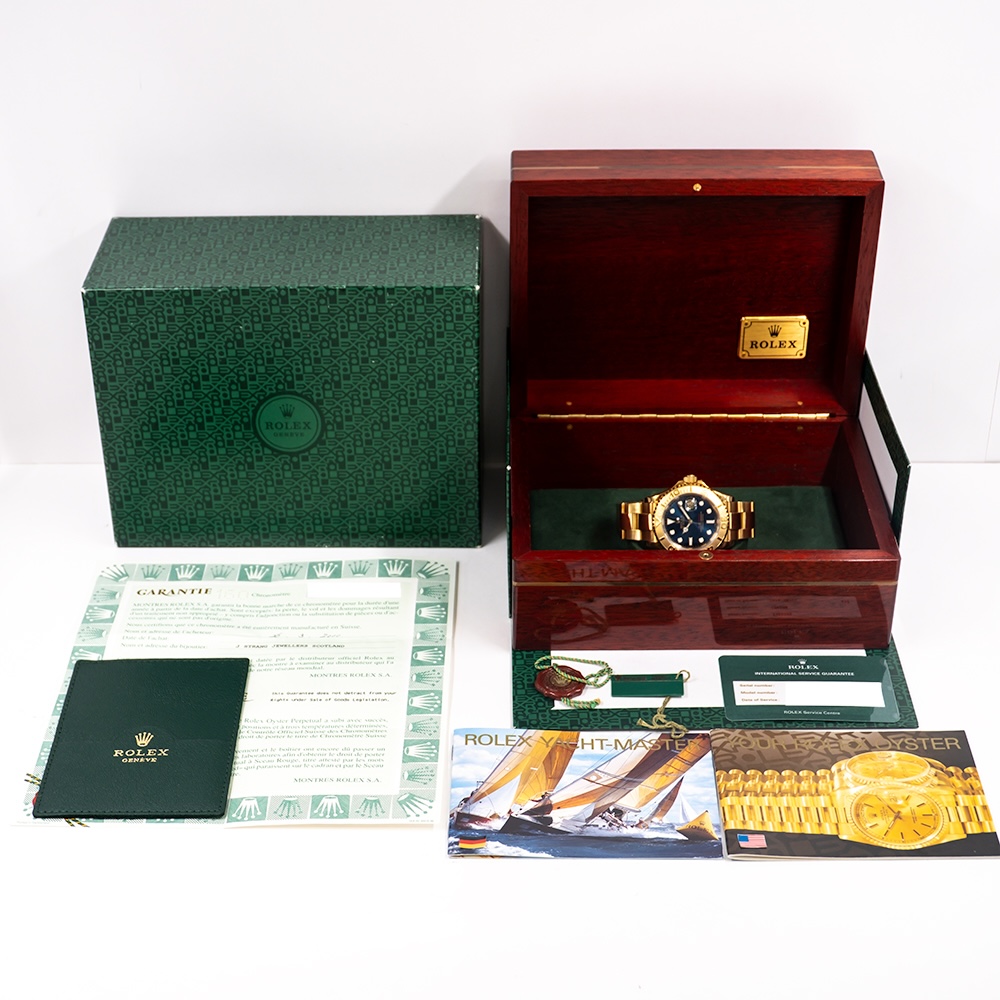
A full set with the warranty card and a documented service lands at the top of every range in this guide. A watch with no papers is still a real watch, but expect to pay less, and expect to pay less again when you sell it. Service records also tell you whether the movement has been maintained or simply worn until it stopped.
Oysterflex wear on the gold and titanium models
The elastomer can show wear near the clasp after years of daily use. Check the inner surface for cracking, deformation or discoloration. A replacement through Rolex service adds real cost, so a worn strap should come off the asking price.
Crystal, dial and lume
Look for any sign of moisture under the crystal, lume that has deteriorated on the hands or markers, and fading on older blue dials that have spent years in the sun. A dial that doesn’t match the reference or generation is a bigger problem than wear, which leads to the trap below.
The Biggest Trap on a Yacht-Master
The most common problem we see is not an outright fake. It is a real watch that has been altered. A bezel refinished at a non-Rolex shop, a replacement dial from a different generation, or a case polished so many times the lines are soft. Each of these knocks real money off the value and none of them show up in a listing photo taken at arm’s length.
Rolesium clones exist too, and the platinum bezel is where they give themselves away. Genuine platinum has a specific weight and a fine, even sandblasted grain, and a steel bezel textured to look like platinum rarely gets both right. If you are buying privately, have the watch checked through our watch authentication service before any money moves. It costs far less than finding out afterward.
The other trap is paying current-model money for an older reference. A 116622 and a 126622 look nearly identical across a table. Confirm the reference between the lugs and the movement before you agree on a number.
Retail vs What to Actually Pay
For most of the line, the pre-owned market sits at or under retail, and that is the headline for anyone shopping in 2026. The 126622 trades roughly at its $13,200 retail. The 126621 trades well under its $19,750 sticker. The 126655 in Everose on Oysterflex trades at $28,400 to $31,000 against $37,700 new, so a lightly worn example saves you several thousand dollars and any wait.
The exception is the 226627 titanium. At $26,000 to $30,500 pre-owned, it carries roughly $10,000 over retail, and if you can get one from an authorized dealer at list, take it. Otherwise, understand you are paying for immediacy and scarcity, not for more watch.
For the new Yacht-Master II, early examples on the secondary market will move around until supply settles. If the regatta function is the point, a first-generation 116680 is the value play. Compare it against the Explorer and Explorer II if you want a steel tool watch in a similar price band with a very different personality.
Built for Salt Air and the Intracoastal
If any Rolex was designed for coastal living, it is the Yacht-Master. West Palm Beach, Jupiter, Fort Lauderdale. Salt air, humidity and the daily swing between air-conditioned offices and 90-degree afternoons are exactly the conditions it was built to handle.
The platinum bezel shrugs off salt air, and the sandblasted finish hides minor contact marks far better than a polished surface. The 100-meter rating is more than enough for pool days, beach swims and the incidental splashes of a day on the boat. Just keep the crown screwed down and have the seals tested every couple of years. Our guide to maintaining water resistance covers what salt water does to gaskets over time.
The Rolesium models also dress up and down better than almost anything else Rolex makes. The cool steel and platinum palette works under a blazer at a Worth Avenue dinner as well as it does with a linen shirt on a sportfisher. And the Yacht-Master draws less attention than a full-gold watch, which some buyers here value more than any spec. If you are cross-shopping deeper divers, our Sea-Dweller vs Submariner comparison covers the tool-watch side of the same coastline.
Buying or Selling a Rolex Yacht-Master in West Palm Beach
WPB Watch Co. is an independent pre-owned dealer and watch repair shop at 1601 Forum Place in West Palm Beach. Every Yacht-Master we sell is authenticated against its reference, checked for original bezel and dial, pressure-tested for water resistance and timed before it goes out. We carry Rolesium, two-tone and gold references across generations as inventory allows.
If you already own a Yacht-Master or another Rolex, we buy and trade. Bring it in or start online through our sell your watch page and we will give you a clear number based on the reference, condition and set. Looking for a specific reference or dial we don’t have listed? Use our request a watch form and we will source it.
Ready to see what is in the case today? Shop our Rolex Yacht-Master collection.
Rolex Yacht-Master FAQ
How much is a Rolex Yacht-Master in 2026?
New, the 40mm Rolesium 126622 retails at $13,200 and the 37mm 268622 at $12,500. Pre-owned in good to excellent condition, a 126622 runs about $13,300 to $16,000, a 116622 about $12,500 to $16,000, and an original 16622 about $9,500 to $12,500. Gold and titanium references run considerably higher.
Is the Rolex Yacht-Master a good investment?
Most Yacht-Masters hold value well without rising much. Rolesium sits near retail and two-tone and gold references trade under it. The 42mm titanium 226627 is the exception, trading roughly $10,000 over retail. Buy it because you want to wear it, not as a trade.
What is the difference between the Yacht-Master and the Submariner?
The Submariner is a 300-meter dive watch with a unidirectional ceramic bezel. The Yacht-Master is a 100-meter luxury sport watch with a bidirectional raised bezel in platinum, gold or ceramic depending on the reference. The Yacht-Master is dressier, and its two-tone and gold references often trade well under retail pre-owned.
What is Rolesium?
Rolesium is Rolex’s combination of Oystersteel and 950 platinum, used on the Yacht-Master. It debuted in 1999 with the 40mm ref. 16622, which paired a steel case with a platinum bezel.
Is the Yacht-Master waterproof enough for swimming?
Yes. The Yacht-Master is rated to 100 meters, which covers swimming, snorkeling and boating. Keep the crown screwed down and have the gaskets pressure-tested periodically, especially if it sees salt water often.
What changed on the new Yacht-Master II?
The 2026 Yacht-Master II drops Ring Command for a simpler system where the lower pusher programs the countdown and the upper one starts and stops it. It runs the new cal. 4162 with a 72-hour reserve, and the countdown hands move counterclockwise, a first for Rolex.
Why is the titanium Yacht-Master so expensive pre-owned?
The 226627 is light, discreet and made in limited enough numbers that demand outruns supply at authorized dealers. That pushes pre-owned prices to about $26,000 to $30,500 against a $16,050 retail.
Need Help with Sales or Service?