
Table of Contents
The Explorer doesn’t shout. It never has. While the Submariner gets the Hollywood wrist shots and the GMT-Master II dominates every airport lounge, the Explorer quietly holds its position as one of Rolex‘s most compelling propositions. No rotating bezel, no date window on the classic references, no flashy complications. Just a time-only watch built to survive the harshest conditions on earth.
That restraint is exactly why collectors keep circling back. The Explorer is a watch you buy because you understand what it represents — not because you need to explain it to anyone else.
This guide covers both the Explorer I and Explorer II, every major reference number worth knowing, and the practical details that matter when you’re shopping the pre-owned market. If you want the full backstory — Tenzing Norgay, the Everest expeditions, the evolution from tool watch to icon — we’ve already written that piece. Read our complete Explorer history and come back here when you’re ready to buy.
Two Watches, One Name
Before we go reference by reference, it helps to understand the fundamental split in the Explorer family. The Explorer I and Explorer II share a name and a legacy, but they’re built for different people with different priorities.
The Explorer I is the purist’s watch. Time only. The signature 3, 6, 9 dial with oversized Arabic numerals. No date complication on the vintage references, though Rolex added a date window on some transitional pieces. At 36mm for most of its life (with one controversial detour to 39mm), it’s the smallest current-production Rolex sport model. The Explorer I is about doing one thing perfectly.
The Explorer II is the tool watch for people who work in environments where daylight doesn’t exist. Speleologists, polar researchers, emergency workers. It adds a fixed 24-hour bezel and an independently adjustable GMT hand — painted bright orange or red depending on the era — so the wearer can track a second timezone or distinguish AM from PM underground. The Explorer II is larger (40–42mm), busier, and significantly more affordable on the secondary market than its GMT-Master II sibling.
Same name. Different watches. Different buyers. Understanding that distinction is the first step toward choosing the right one.
The Explorer I Through the Generations
The Vintage Icons
Reference 1016 (1963–1989) — This is the Explorer that collectors obsess over, and for good reason. A 26-year production run gave us an enormous range of dial variations, from early gilt dials with gold-printed text to later matte dials with white printing. The 1016 is a 36mm watch with an acrylic crystal, powered by the Cal. 1560 (early production) and later the Cal. 1570. No date. No crown guard. Just the 3, 6, 9 Explorer dial in its purest form.
Gilt-dial examples from the early to mid-1960s command the most dramatic premiums, and a tropical gilt dial — where the black has faded to brown — can push well into six figures at auction. Even later matte-dial 1016s have appreciated significantly. This is a reference where dial originality is everything. A refinished dial can cut the value in half or worse.
Reference 14270 (1989–2001) — The first Explorer with a sapphire crystal, marking Rolex’s shift toward modern materials. Still 36mm. Powered by the Cal. 3000. The 14270 introduced a cleaner, more contemporary look while keeping the essential Explorer formula intact. Early examples have tritium lume (which develops a warm patina over time), while later production switched to Luminova (which stays white). That transition is a key detail for collectors who care about period correctness.
The Modern Era
Reference 114270 (2001–2010) — Powered by the Cal. 3130, the 114270 brought solid end links (SEL) to the Explorer, which eliminated the hollow rattle of earlier bracelets. Still 36mm. Still no date. This is the last Explorer I made in what many consider the “right” size, and it represents strong value on the pre-owned market for anyone who wants a modern movement in a classic package.
Reference 214270 (2010–2021) — Rolex made two controversial decisions with this reference. First, the case grew to 39mm — a significant jump that divided the collector community. Second, the initial production (known as the “Mark I” dial) featured 3, 6, and 9 numerals without luminous fill, leaving them as dark outlines against the black dial. Collectors were vocal about the legibility issue, and Rolex responded in 2016 with the “Mark II” dial, which restored lumed numerals. The movement is the Cal. 3132 with Rolex’s Parachrom hairspring. Good watch, wrong size — that’s the consensus, and prices reflect it.
Reference 124270 (2021–present) — The correction the market had been waiting for. Rolex returned the Explorer I to 36mm and installed the Cal. 3230, a next-generation movement with a 70-hour power reserve (up from the previous 48 hours). The case finishing is refined, the bracelet is excellent, and the overall proportions feel right again. The 124270 is the current-production Explorer and arguably the most well-rounded version Rolex has ever made.
The Explorer II
The Birth of the Dual-Timezone Explorer
Reference 1655 (1971–1985) — The original Explorer II, designed for scientists and explorers working in caves, polar regions, and other environments where you literally cannot tell day from night. The fixed 24-hour bezel and distinctive orange GMT hand (often called the “Freccione” by Italian collectors) made it a tool watch with a clear purpose. Collectors sometimes call this the “Steve McQueen,” though there’s little evidence McQueen ever actually wore one. Regardless of the nickname’s accuracy, the 1655 has become one of the most collectible vintage Rolex sport models. Prices reflect that status.
The Modern Explorer II
Reference 16570 (1989–2011) — The 16570 is where the Explorer II became an accessible dual-timezone Rolex. Available in both white and black dials, powered by the Cal. 3185 (early production) and Cal. 3186 (later production with the Parachrom hairspring). The white-dial version, sometimes called the “Polar,” is particularly sought after — it’s one of the few white-dial Rolex sport watches and photographs beautifully. At 40mm, the 16570 wears perfectly on most wrists and remains one of the best value propositions in the entire Rolex catalog.
Reference 216570 (2011–2021) — Rolex bumped the Explorer II to 42mm and gave it the “Maxi” case treatment — thicker lugs, broader crown guards, a more imposing presence on the wrist. The orange GMT hand returned after decades of red hands on the 16570, visually linking the modern watch back to the original 1655. Cal. 3187 powers this reference. The 216570 is a substantial watch that works better on larger wrists.
Reference 226570 (2021–present) — The current-production Explorer II. Same 42mm diameter as its predecessor, but Rolex slimmed down the case profile noticeably, which makes it feel lighter and more refined on the wrist. The Cal. 3285 delivers a 70-hour power reserve. The white dial is the collector’s choice here — it’s distinctive, versatile, and has legitimate waiting-list demand at authorized dealers. The black dial is equally capable but more understated.
Every Major Explorer Reference at a Glance
| Reference | Model | Size | Years | Movement | Key Notes |
|---|---|---|---|---|---|
| 1016 | Explorer I | 36mm | 1963–1989 | Cal. 1560/1570 | Vintage icon. Acrylic crystal. |
| 14270 | Explorer I | 36mm | 1989–2001 | Cal. 3000 | First sapphire crystal. |
| 114270 | Explorer I | 36mm | 2001–2010 | Cal. 3130 | SEL. Last classic Explorer. |
| 214270 | Explorer I | 39mm | 2010–2021 | Cal. 3132 | Size increase. Mark I/II dials. |
| 124270 | Explorer I | 36mm | 2021–present | Cal. 3230 | Return to 36mm. 70-hr reserve. |
| 1655 | Explorer II | 40mm | 1971–1985 | Cal. 1575 | “Steve McQueen.” Fixed bezel. |
| 16570 | Explorer II | 40mm | 1989–2011 | Cal. 3185/3186 | White/black dial. Workhorse. |
| 216570 | Explorer II | 42mm | 2011–2021 | Cal. 3187 | Maxi case. Orange hand. |
| 226570 | Explorer II | 42mm | 2021–present | Cal. 3285 | 70-hr reserve. Slimmer profile. |
Explorer I or Explorer II
This is the question every Explorer buyer faces, and the answer depends entirely on what you want from a watch.
Choose the Explorer I if you value simplicity above everything else. It’s smaller, thinner, and more versatile than almost any other Rolex sport model. No complications to fuss with, no bezel to accidentally bump. The 36mm case (on the current 124270 and most vintage references) fits under a dress shirt cuff without a fight. The Explorer I is the watch for someone who believes that the best design is the one with nothing left to remove.
Choose the Explorer II if you want more wrist presence and a genuine complication. The dual-timezone function is practical if you travel or work across time zones, and it comes at a significantly lower price point than the GMT-Master II. The white-dial Explorer II (in any reference) is one of the most distinctive watches Rolex makes — it reads completely differently from the standard black-dial sport watches that dominate the lineup. If you want a Rolex GMT function without the hype premium, the Explorer II is where the smart money goes.
Pre-Owned Pricing in Early 2026
Pre-owned pricing fluctuates with market conditions, but these ranges reflect where the major Explorer references are trading as of Q1 2026. Condition, box and papers, and dial originality all affect where a specific example falls within the range.
| Reference | Model | Price Range (USD) |
|---|---|---|
| 1016 | Vintage Explorer I | $25,000–$60,000+ (gilt dials higher) |
| 14270 | Explorer I | $6,500–$9,000 |
| 114270 | Explorer I | $7,000–$9,500 |
| 214270 | Explorer I (39mm) | $8,000–$11,000 |
| 124270 | Explorer I (current) | $8,500–$11,500 |
| 1655 | Vintage Explorer II | $30,000–$80,000+ |
| 16570 White | Explorer II | $9,000–$12,500 |
| 16570 Black | Explorer II | $8,000–$11,000 |
| 216570 | Explorer II | $11,000–$14,000 |
| 226570 White | Explorer II | $12,000–$15,000 |
| 226570 Black | Explorer II | $11,000–$13,500 |
Notice the premium that white-dial Explorer II references command over their black-dial counterparts. That gap has widened over the past two years and shows no signs of closing. Also worth noting — the 214270 (the 39mm Explorer I) is currently the most affordable modern Explorer I on the secondary market, partly because collectors still haven’t fully forgiven the size change.
What to Check Before Buying
Buying a pre-owned Explorer — especially a vintage one — requires attention to detail. Here’s what separates a smart purchase from an expensive mistake. If you’re new to the authentication process, our guide on how to spot a fake Rolex covers the fundamentals.
Dial originality. This is the single most important factor on a vintage Explorer, particularly the 1016. A refinished dial — even one done well — can reduce the watch’s value by 30–50%. Learn to read lume plots, font spacing, and printing quality. Original gilt dials should show age-appropriate patina, not a uniform matte finish.
Lume type tells you the era. Tritium (pre-1998) develops a warm cream or brown patina over decades. Luminova (late 1990s–early 2000s) stays whiter. Chromalight (modern references) glows blue. If the lume type doesn’t match the production period, either the dial has been replaced or something else is wrong.
The 214270 Mark I vs. Mark II dial. If you’re buying the 39mm Explorer, check whether it has the original “blackout” numerals (Mark I, 2010–2016) or the corrected lumed numerals (Mark II, 2016–2021). The Mark II is generally preferred for daily wear and commands a slight premium.
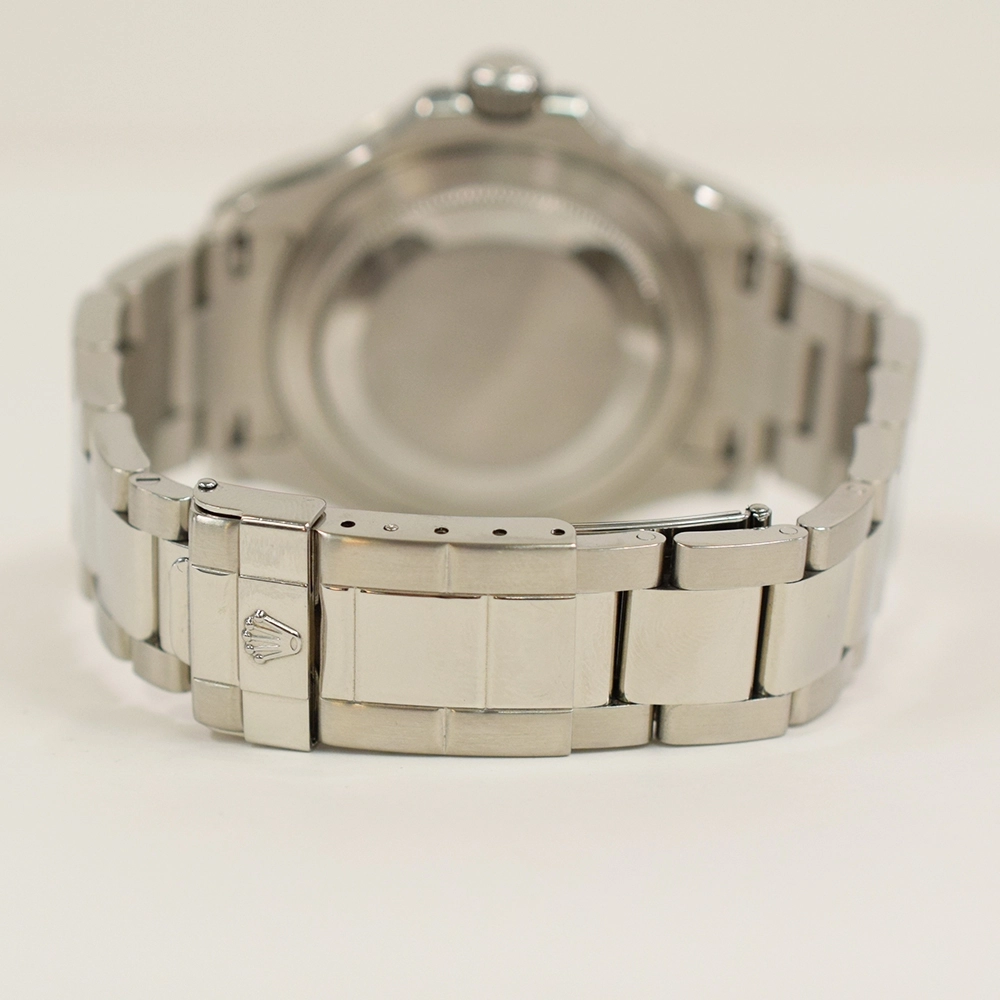
Bracelet condition. Vintage Explorer bracelets develop stretch over decades of wear. Excessive stretch lowers value and can make the watch uncomfortable. Check the clasp for play and the links for gaps. Replacement bracelets are available, but original-bracelet examples carry a premium. If you plan to keep the watch long-term, read our guide on maintaining your watch’s water resistance — it applies to bracelet seals as well.
Explorer II bezel and GMT hand. On the Explorer II, confirm that the 24-hour bezel is properly aligned and that the GMT hand sets independently (on Cal. 3185/3186/3187/3285 references). A GMT hand that doesn’t jump cleanly to the next hour position suggests a movement issue that will be expensive to address.
Service history matters, but not the way you’d think. A fully serviced vintage Explorer with replacement hands, dial, or crystal is worth less than an unserviced example with all original parts in honest condition. Collectors pay for originality. That said, any watch you plan to wear daily should be mechanically sound. Our overhaul guide explains the service intervals and what to expect.
The Explorer as a One-Watch Collection
If someone asked us to recommend a single watch — one watch to wear every day for the rest of your life — the Explorer I would be on a very short list.
The current 124270 makes the strongest case. At 36mm, it fits virtually any wrist size without looking too large or too small. The Oyster bracelet is comfortable enough for all-day wear. The 70-hour power reserve means you can take it off Friday evening and strap it back on Monday morning without resetting. And the 3, 6, 9 dial is arguably the most legible layout Rolex produces — cleaner than the Submariner, more readable than the Datejust.
But the real argument is versatility. The Explorer works with a suit at a board meeting. It works with jeans and a t-shirt on the weekend. The Explorer works under a wetsuit, at a job site, or on a trail. It doesn’t attract attention from people who aren’t watch enthusiasts, which is a feature, not a bug. And to the people who do notice, it says something specific about the wearer — that you chose substance over flash.
The Explorer II makes a similar case if you need the GMT function, but the larger size and busier dial make it slightly less universal. For a true one-watch collection, the Explorer I is hard to beat.
Why Buy Your Explorer from WPB Watch Co
Every Explorer that passes through WPB Watch Co receives a thorough inspection that goes well beyond a basic authenticity check. We verify dial originality down to the lume plots and printing characteristics — critical for vintage Explorer I references where a refinished dial can mean a five-figure difference in value. Our authentication process examines case serial engravings, movement finishing, and component consistency across the entire watch.
We maintain a rotating inventory of both Explorer I and Explorer II references, from vintage 1016s to current-production 226570s. Browse our available Explorer II collection and full Rolex inventory online, or contact us directly if you’re looking for a specific reference. If you have an Explorer you’d like to move, we also buy and accept trades.
You May Also Like
Need Help with Sales or Service?