
Table of Contents
For eighty years Rolex made five bracelets. Then in 2025 it quietly added two more, and almost every guide to Rolex bracelet types online is now out of date.
That matters more than it sounds. The bracelet is roughly half the metal on the watch, it is the part that touches you all day, and on a pre-owned Rolex it is the component most likely to have been swapped, stretched or replaced. Two watches with identical dials and identical cases can sit twenty percent apart in value because of what is attached to the lugs.
This guide covers all seven Rolex bracelet types, the clasps and extension systems that go with them, and how to tell a healthy bracelet from a tired one. Where it helps, we point at watches sitting in our case in West Palm Beach right now, because a photograph of a bracelet tells you less than the weight of one.
The Seven Rolex Bracelet Types at a Glance
| Bracelet | Introduced | Link pattern | Typically found on |
|---|---|---|---|
| Oyster | Late 1930s | Three-piece flat links | Submariner, GMT-Master II, Daytona, Explorer, Datejust, Oyster Perpetual |
| Jubilee | 1945 | Five-piece, two large outer and three small polished center | Datejust, GMT-Master II, Sky-Dweller, Lady-Datejust |
| President | 1956 | Semi-circular three-piece links | Day-Date, some Lady-Datejust |
| Pearlmaster | 1992 | Rounded five-piece links | Pearlmaster, gem-set Lady-Datejust |
| Oysterflex | 2015 | Metal blades under elastomer | Yacht-Master, Daytona, Sky-Dweller in gold |
| Flat Jubilee (integrated) | 2025 | Five flat links, three polished and raised | Land-Dweller |
| Settimo | 2025 | Seven rounded domed links | Perpetual 1908 in yellow gold |
Five of these you will meet regularly on the pre-owned market. Two of them are so new that a used example barely exists yet. We will take them in order.
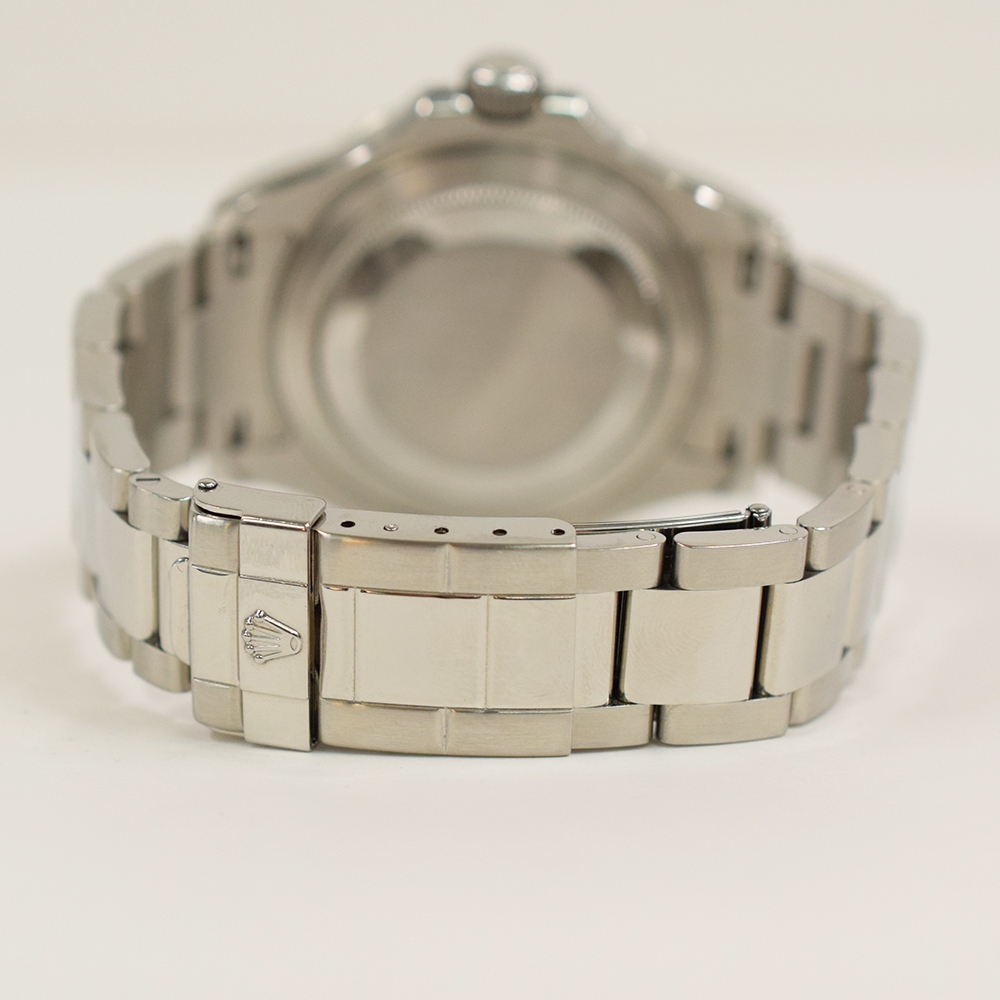
The Oyster Bracelet
The Oyster is the one most people picture. Rolex describes it as three-piece links, which means each link is built from three separate pieces of metal joined across the width of the bracelet: a broad brushed center section flanked by two narrower polished or brushed outer sections. Rolex traces it to the late 1930s and does not publish a single launch date, which is why you will see everything from 1937 to 1947 quoted around the internet.
It is the sports bracelet. Submariner, GMT-Master II, Sea-Dweller, Explorer, Daytona, Air-King, and a great many Datejusts and Oyster Perpetuals as well. Flat, wide, mostly brushed, and stiffer on the wrist than anything else Rolex makes in metal. That stiffness is the point. An Oyster holds its shape under load and it does not catch on a wetsuit cuff.
If you are choosing between Rolex bracelet types for a watch you plan to wear hard, the Oyster is the default answer and there is no argument to be had about it.
The Jubilee Bracelet
Rolex launched the Jubilee in 1945 to mark forty years of the company, and built it specifically for the watch it launched the same year, the Datejust. Rolex describes the construction as two large satin-finished links flanking three smaller polished links. Five pieces across instead of three, with the polished center row running down the middle like a stripe.
Two consequences follow from those extra links. The Jubilee drapes. More articulation points means it wraps a wrist rather than sitting across it, and people who find an Oyster rigid often find the Jubilee disappears. The second consequence is that it catches light constantly, because those three polished center links are always at a different angle to the brushed outer ones. It reads as jewelry in a way the Oyster does not.
It started as a Datejust bracelet and has stayed one, but it has spread. The GMT-Master II has worn a Jubilee on and off since the sixties, and the current Pepsi and Batman references are sold on both. The Sky-Dweller offers it. So does most of the Lady-Datejust line.
Oyster vs Jubilee, and How to Actually Choose
This is the decision most buyers are actually making, and the advice online tends to collapse into sporty versus dressy, which is true and useless. Here is what separates them in practice.
| Oyster | Jubilee | |
|---|---|---|
| Links across | Three | Five |
| On the wrist | Stiffer, sits flatter | Drapes, wraps more |
| Finish | Mostly brushed | Polished center row throughout |
| Under a shirt cuff | Catches on the hem more | Slides |
| Scratches | Hides them | Shows them on the polished links |
| Cleaning | Easy | Traps grime between the small links |
| Perceived weight | Feels solid | Feels lighter at the same actual weight |
| Best with | Sports models, larger wrists | Datejust, smaller wrists, dress use |
Three practical notes that rarely make it into the oyster vs jubilee argument. First, the Jubilee’s small center links collect skin oil and soap, and if a Jubilee has never been cleaned properly you will see it as a dark line down the middle. That is maintenance, not damage. Second, the Jubilee’s extra joints mean more places to wear, so a heavily used Jubilee usually shows stretch before an Oyster of the same age does. Third, on a wrist under about 6.5 inches the Jubilee tends to look better in photographs and feel better in life, because it curves harder at the lugs.
Neither is worth more. What is worth money is originality, and we come back to that below.
The President Bracelet
Rolex introduced the President in 1956 alongside the Day-Date and has never made it in steel. Rolex’s own description is unusually firm on this point: semi-circular three-piece links, produced exclusively in 18 karat gold or 950 platinum since 1956.
Three links across like an Oyster, but where the Oyster is flat the President is domed. Each link curves in section, so the bracelet reads as a series of small rounded bars rather than flat plates. The center link is polished, the outer links satin, and the whole thing is thicker and heavier than it looks because there is no steel anywhere in it.
It closes with a concealed Crownclasp, which we cover further down, so there is no visible clasp cover at all. From the outside the bracelet appears to be an unbroken loop of gold. That is the whole design intent, and it is why the President still looks different from every other gold bracelet on the market seventy years later.
If someone offers you a “steel President”, they are describing a Jubilee or an aftermarket copy. Rolex has never built one.
The Pearlmaster Bracelet
Rolex launched the Pearlmaster bracelet in 1992 for the Pearlmaster line, and it is the most decorative thing the company makes in metal: five rounded links across, all of them domed, all of them polished, and built in gold or platinum only. It also carries the concealed Crownclasp.
One thing to flag, because most guides get it wrong. As of August 2026 the Pearlmaster does not appear on Rolex’s own bracelets page at all, while the Oyster, Jubilee, President, Oysterflex, flat Jubilee and Settimo all do. Dealer guides that list it as a current option are working from older material. It remains a real bracelet on a great many real watches, and you will meet it on the pre-owned market and on gem-set Lady-Datejust models. It is simply no longer part of what Rolex presents as its bracelet range.
The Oysterflex Bracelet
Rolex introduced the Oysterflex in 2015 on the Yacht-Master 37, and it is the one people get wrong most often, because it looks like a rubber strap and is sold as a bracelet. Rolex is precise about the difference and so should any dealer be.
Inside are two flexible metal blades running the length of the strap. Those blades are then overmolded with a high-performance elastomer. What you touch is elastomer. What holds the watch on your wrist is metal, with the flex characteristics of a spring rather than the stretch characteristics of rubber. The blades are reported by multiple dealers to be a titanium and nickel alloy, though Rolex’s current page says only “supple metal blades” without naming the material.
On the underside, Rolex molds a set of raised cushions. They lift the body of the bracelet a fraction off the skin, which lets air move underneath and stops the watch sliding around when your wrist is wet. Anyone who has worn a conventional rubber strap in Florida in August will understand immediately why that exists.
It closes with an Oysterlock safety clasp, not a buckle, and it is fitted almost exclusively to gold watches: gold Yacht-Masters, gold Daytonas, gold Sky-Dwellers. If a listing describes a modern gold Yacht-Master as being on a “rubber strap”, the listing is imprecise. It is on an Oysterflex.
The Two Rolex Bracelet Types Added in 2025
Here is where most guides stop, and here is where they are now wrong. Rolex added two entirely new bracelets in 2025 and both are listed on its own bracelets page today.
The Flat Jubilee, on the Land-Dweller
Rolex launched the Land-Dweller in 2025 and gave it an integrated bracelet it calls the flat Jubilee. Five links across, keeping the Jubilee’s proportions, but flat rather than domed, with three of the links polished and raised slightly in the center. The attachment to the case is invisible, so the bracelet appears to grow out of the case rather than bolt onto it.
Integrated bracelets are not new to Rolex. It built them for the Oysterquartz in the late seventies. But this is the first new integrated design in decades, and it arrived attached to the first genuinely new Rolex case shape in a very long time, running the caliber 7135 with the Dynapulse escapement.
The Settimo, on the Perpetual 1908
The Settimo takes its name from the Italian for seventh, and it is seven links across: seven rounded, domed, solid gold links, arranged in a staggered pattern so the bracelet articulates in more places than any other Rolex makes. Yellow gold only so far, on the 39mm Perpetual 1908, and closed with a concealed Crownclasp.
Seven links across a 39mm watch means each link is narrow, which is exactly why it moves the way it does. It is the softest metal bracelet Rolex has ever made, and it costs a great deal more than the leather strap version of the same watch.
Neither of these will show up in the pre-owned market in volume for several years. They are here so that when you read a bracelet guide that lists five, you know it was written before 2025.
Rolex Clasps, Which Matter More Than the Links
The clasp is where a bracelet fails, where it gets adjusted, and where a swap is easiest to spot. Rolex uses three, and the names get muddled constantly.
| Clasp | What it is | Where you find it |
|---|---|---|
| Oysterclasp | Folding clasp with a visible cover, no secondary lock | Datejust, Oyster Perpetual and other classic models on Oyster or Jubilee |
| Oysterlock | The same folding clasp with an added safety catch that has to be lifted before the clasp will open | Professional models: Submariner, GMT-Master II, Sea-Dweller, Explorer II, Yacht-Master, and every Oysterflex |
| Crownclasp | Two folding blades under a completely concealed lock, released by a crown-shaped lever | President, Pearlmaster, Settimo, and some Jubilee bracelets |
The practical difference between an Oysterclasp and an Oysterlock is one gesture. On an Oysterclasp you lift the cover and the bracelet opens. On an Oysterlock you must first flip up a small hinged catch that sits over the cover, then lift the cover. Rolex puts the second one on watches it expects to be knocked against things.
The Crownclasp is the invisible one. Look at a Day-Date from above and there is no clasp: the links run unbroken around the wrist with only a small coronet marking where the release sits. Two folding blades hide underneath. It is the most elegant of the three and the one most likely to need service, because the concealed lock has more to go wrong and less room to do it in.
Easylink, Glidelock and Fliplock, Explained
Separate from the clasp itself, Rolex builds three tool-free extension systems into the clasp cover. These are the features owners most often do not know they have.
| System | Adjustment | How it works | Found on |
|---|---|---|---|
| Easylink | About 5 mm | An extra link folded under the clasp cover. Unclip it and the bracelet lengthens; clip it back and it shortens. One movement, no tools. | Datejust, Oyster Perpetual, Explorer, most non-dive models |
| Glidelock | Up to about 15 or 20 mm depending on model, notch by notch | A toothed rack under the clasp cover. Slide the bracelet along it and it locks at each notch. Widely reported as 2 mm per notch, though Rolex publishes the range rather than the increment. | Submariner, Sea-Dweller, Deepsea, and Oysterflex models |
| Fliplock | About 26 mm | Three folding blades stored under the clasp cover. Unfold them for a wetsuit. | Deepsea and Deepsea Challenge |
Easylink is the one that matters to most owners, because wrists swell. Yours is measurably larger at four in the afternoon in a Florida summer than it was at eight that morning, and 5 mm is roughly the difference. If your Rolex is tight by the end of the day and you have been living with it, open the clasp and look underneath. The extra link is probably there.
Glidelock is the reason modern Submariner owners rarely need a jeweler. It gives you fine adjustment across a range that used to require removing a link, and it does it without tools. On a Deepsea, Glidelock and Fliplock work together, and Rolex specifies the combination as enough to clear a 7 mm wetsuit.
Riveted, Folded, Solid: How the Links Themselves Changed
This section decides value on vintage watches, and it contains a distinction that most guides run together and get wrong.
Early Oyster bracelets used riveted links, with visible rivet heads on the outer links. Through the fifties and sixties Rolex moved to folded links, where the metal is stamped and folded into a hollow shape. Folded links are light, they rattle audibly, and they wear at the joints. Solid links took over around 1975 and gave the modern Oyster its heft.
Here is the part that trips people up. Solid links and solid end links are two different changes about twenty five years apart. The end links are the two curved pieces that connect the bracelet to the case between the lugs. Rolex kept those hollow long after the bracelet links themselves went solid, and moved to solid end links gradually through the early 2000s, model by model. The Submariner 14060M was still leaving the factory with folded end links as late as 2010.
So a 1990s Submariner with solid center links and hollow end links is not a Frankenstein and nobody has swapped anything. That is how Rolex built it. If you are looking at a watch from that window and a seller tells you the hollow end links prove it has been messed with, the seller does not know the bracelet history.
Push the end link with a fingernail on a vintage Oyster. If it flexes and pings, it is folded. If it does not move, it is solid. That one test tells you more about the era of the bracelet than any chart will.
Stretch, and What a Tired Bracelet Costs You
Rolex bracelets do not stretch in the sense of the metal getting longer. What happens is that the pins wear, the holes they run through elongate, and the accumulated slack across forty or fifty joints turns into visible sag. On a bracelet with more joints, which means a Jubilee, it accumulates faster.
Test it the way we do. Hold the watch by the case with the bracelet hanging and grip the clasp end. Pull gently apart, then push together. A healthy bracelet moves almost nothing. A worn one opens visible gaps between the links and you can watch daylight appear along its length. Then hold it flat by one end. A tired bracelet droops in a smooth curve instead of holding roughly straight.
Stretch is not repairable in any economic sense. Individual links can be replaced, but a uniformly worn bracelet needs replacing whole, and on a gold watch that number can be startling. This is a large part of why bracelet condition moves the price of a pre-owned Rolex, and why it belongs in any serious conversation about what determines the value of a Rolex.
The bigger value question is originality. A correct, period-appropriate bracelet with matching end link codes is part of the watch. A modern replacement bracelet on a 1970s case is a serviceable watch and a weaker asset, and on vintage references the gap is not small. This is one of the things we check first, and it is covered in our guide to how to authenticate a Rolex.
Sizing, Links and Fit
Every Rolex bracelet leaves the factory with a standard number of links, and sizing works by removing them in pairs so the clasp stays centered on the underside of your wrist. Get that wrong and the watch sits crooked no matter how well it fits.
Link counts vary by model and by bracelet, and we keep a separate reference for them. If you need to know how many links your reference should have, or how much length each one adds, use our Rolex link count guide rather than guessing.
Five Bracelets, Five Watches in Our Case
Reading about Rolex bracelet types only goes so far. Every one of the five bracelets you are likely to encounter is on a watch in our showroom as this is published, so here they are with references and prices.
- Oyster. A 1973 Submariner Date reference 1680 at $17,150. Fifty three years old, and the bracelet still tells you what the Oyster is for the moment you pick it up.
- Jubilee in steel. A 2026 Datejust 41 reference 126334 at $18,675, blue Roman dial with a white gold fluted bezel. The Jubilee on its original watch, which is where it started in 1945.
- Jubilee in gold. A 2025 GMT-Master II reference 126718GRNR at $49,150, solid yellow gold throughout. Put it next to the steel Datejust and the same link pattern reads as a completely different object.
- President. A 1978 Day-Date 36 reference 18038 at $24,450, champagne stick dial, 18 karat yellow gold. Twenty two years after the President launched and the design had not changed, which is the whole story of this bracelet.
- Oysterflex. A 2024 Yacht-Master 42 reference 226658 at $37,100 in yellow gold. Pick it up and the weight tells you there is metal inside what looks like rubber.
The Pearlmaster is the gap. We do not have one in the case today, and rather than substitute a photograph we would rather say so. If a Pearlmaster is what you are after, tell us and we will look.
The rest of the inventory is on our Rolex collection page, and if you are earlier in the process our guide to first Rolex models for first-time buyers covers the ground before bracelets become the deciding factor.
Handling Rolex Bracelets in West Palm Beach
Nobody has ever chosen between an Oyster and a Jubilee from a photograph and been sure about it. The difference is in the drape and the weight, and both take about four seconds to settle once the watch is on your wrist.
We are at 1601 Forum Pl #1010 in West Palm Beach. Come in and try the five side by side. We will size whatever you buy on the spot, show you where your Easylink or Glidelock is and how to use it, and check the bracelet on anything you already own while you are here. If you are selling, bracelet condition is one of the first things we assess, and our guide on how to sell your Rolex explains what else goes into the number. Call 561-220-9107 to tell us what you want on the bench when you arrive.
Rolex Bracelet Questions, Answered
How many Rolex bracelet types are there?
Seven. Oyster, Jubilee, President, Pearlmaster, Oysterflex, and two introduced in 2025: the flat Jubilee on the Land-Dweller and the Settimo on the Perpetual 1908. Most guides online list four or five because they were written before 2025. Rolex no longer lists the Pearlmaster among its current bracelets, though plenty exist on watches.
What is the difference between an Oyster and a Jubilee bracelet?
The Oyster has three links across and the Jubilee has five. The Oyster is flatter, stiffer and mostly brushed, which suits sports models. The Jubilee has a polished center row and more articulation points, so it drapes more and reads as dressier. Neither is worth more than the other at resale. What affects value is whether the bracelet is original and correct for the watch.
Does Rolex make a President bracelet in steel?
No. Rolex has produced the President bracelet exclusively in 18 karat gold or 950 platinum since 1956. Anything sold as a steel President is either a Jubilee being described loosely or an aftermarket bracelet.
Is the Oysterflex a rubber strap?
No, and Rolex classes it as a bracelet rather than a strap. It is built around two flexible metal blades that are overmolded with a high-performance elastomer, so the elastomer is the surface and the metal carries the load. It has cushions molded into the underside for airflow and stability, and it closes with an Oysterlock safety clasp rather than a buckle.
What is the difference between Easylink and Glidelock?
Easylink is a single folded link under the clasp that gives about 5 mm in one movement, and it appears on models like the Datejust and Explorer. Glidelock is a toothed rack under the clasp that adjusts up to roughly 15 or 20 mm notch by notch, and it appears on dive models and Oysterflex bracelets. Easylink is one step, Glidelock is many small ones.
How can I tell if a Rolex bracelet is stretched?
Hold the case in one hand and the clasp end in the other, then pull gently apart and push together. A healthy bracelet barely moves. A worn one opens visible gaps between links. Then hold the bracelet flat from one end: a tired one droops in a smooth curve. Stretch comes from worn pins and elongated pin holes rather than from the metal lengthening, and it is not economically repairable.
Why does my older Submariner have hollow end links?
Because that is how Rolex built it. The bracelet links went solid around 1975, but the end links that join the bracelet to the case stayed hollow and folded for another twenty five years. Rolex moved to solid end links gradually through the early 2000s, model by model, and the Submariner 14060M kept folded end links as late as 2010. Hollow end links on a watch from that period are correct, not evidence of a swap.
You May Also Like
Need Help with Sales or Service?