
Table of Contents
An Omega Speedmaster Professional is the rare icon you can still buy below retail. A current 3861 Moonwatch with the hesalite crystal lists at $7,800 on the steel bracelet in 2026, and clean pre-owned examples trade from about $4,400 to $5,800. Step back to the 1861 generation and $3,500 buys the same case, the same dial layout and the same Moon story.
Vintage is a different market entirely. A cal 861 reference 145.022 runs roughly $7,000 to $18,000, Apollo-era cal 321 pieces start near $20,000, and a correct CK2915 from 1957 clears $50,000. The rest of this guide walks through every reference that matters, why the numbers land where they do, and what we check before a Speedmaster goes in our case.
Omega Speedmaster Prices at a Glance
Figures below are fall 2026 pre-owned ranges for examples in good to excellent condition. Box and papers, a recent service with documentation, and unpolished cases push a watch toward the top of each range. Missing paperwork or replaced parts pull it toward the bottom.
| Model / Reference | Movement | Pre-Owned Range (2026) |
|---|---|---|
| Moonwatch 3861, hesalite, bracelet | Cal 3861 | $4,400–$5,800 |
| Moonwatch 3861, sapphire sandwich | Cal 3861 | $5,500–$6,800 |
| Moonwatch 311.30.42.30.01.005 (hesalite) | Cal 1861 | $3,500–$4,500 |
| Moonwatch 311.30.42.30.01.006 (sapphire) | Cal 1861 | $4,000–$5,500 |
| Moonwatch 3570.50 | Cal 1861 | $3,500–$5,500 |
| Moonwatch 3590.50 | Cal 861 | $4,500–$7,500 |
| White dial 310.30.42.50.04.001 (2024) | Cal 3861 | $7,800–$8,900 |
| Reverse panda 310.30.42.50.01.004 (2026) | Cal 3861 | $9,800–$10,400 |
| Vintage 145.022 | Cal 861 | $7,000–$18,000 |
| Vintage 105.012 / 145.012 | Cal 321 | $20,000–$45,000+ |
| Vintage CK2915 | Cal 321 | $50,000–$80,000+ |
| Speedmaster Reduced 3510.50 | Automatic | $2,500–$4,000 |
Strap versions of the modern Moonwatch usually sit a few hundred dollars under the bracelet pieces. The bracelet is worth having, and it costs real money to add later.
Why a Speedmaster Costs What It Does
NASA chose it and the Moon made it famous
Omega introduced the Speedmaster CK2915 in 1957 as a racing chronograph with a tachymeter bezel and broad arrow hands. NASA put a handful of chronographs through brutal testing, and in 1965 the Speedmaster came out the other side flight-qualified. Four years later, in July 1969, it was on the wrist of an astronaut standing on the Moon during Apollo 11. No marketing budget can buy that, and the price of every Speedmaster since carries a little of it.
Omega never stopped making it
The modern Moonwatch still looks like the watch that went to the Moon. Same asymmetric case, same black dial with three subdials, same manual-wind movement you wind every morning. That continuity is why a 2026 watch and a 1980s watch pull from the same pool of buyers, and why the model never falls out of fashion long enough to crash in value.
The movement is the map
Speedmaster pricing follows its calibers. The column-wheel cal 321 powered the early references and commands the biggest money. The cal 861 took over in 1968, the cal 1861 carried the line through the 1990s and into 2021, and the cal 3861 Co-Axial Master Chronometer arrived in January 2021. Know which movement sits inside a watch and you already know roughly what bracket it lives in.
Supply keeps modern prices honest
Omega makes a lot of Moonwatches, and plenty of them come back to market every year. That steady supply is exactly why the used price sits well under retail. It is great news for buyers and a reality check for sellers who paid full retail two years ago.
What Is the Cheapest Omega Speedmaster?
The cheapest way into the Speedmaster name is the Speedmaster Reduced, reference 3510.50, a 39mm automatic that trades from $2,500 to $4,000. It is a fine watch, and it is not a Moonwatch. It uses an automatic movement with a dial layout that differs from the Professional, and it never had the flight heritage.
If you want the real Moonwatch, the value floor is the 1861 generation. A 3570.50 or a 311.30.42.30.01.005 in the $3,500 to $4,500 zone gets you the manual-wind Professional with the hesalite crystal, which is the configuration closest to what astronauts actually wore. For most first-time buyers, that is the one we point them to.
Why Is It Called the Moonwatch?
Because it went there. The Speedmaster was the chronograph NASA issued to its astronauts, and Apollo 11 put one on the lunar surface in 1969. The nickname stuck so hard that Omega now prints it on the dial and uses it as the official name of the line.
Apollo 13 added the second chapter. After the explosion that crippled the spacecraft in 1970, the crew used a Speedmaster to time a critical engine burn to get home. NASA recognized Omega with the Silver Snoopy Award, and that episode has since inspired some of the most collectible limited editions Omega has made. We cover more of the story side in our post on why the Speedmaster Moonwatch still dominates collector circles. This guide sticks to the money.
Speedmaster Moonwatch Prices by Reference
These are the references that account for nearly every Moonwatch we see. Pre-owned ranges assume good to excellent condition, and complete sets with service history land in the upper half.
| Reference | Years | Size | Movement | Notes |
|---|---|---|---|---|
| CK2915 | 1957 | 39mm | Cal 321 | The original, broad arrow hands, $50,000–$80,000+ |
| 105.003 | Mid 1960s | 39mm | Cal 321 | The Ed White reference, $15,000–$35,000 |
| 105.012 / 145.012 | Mid to late 1960s | 42mm | Cal 321 | Apollo era, $20,000–$45,000+ |
| 145.022 | About 1969 to late 1980s | 42mm | Cal 861 | Long-running vintage workhorse, $7,000–$18,000 |
| 3590.50 | About 1988 to 1996 | 42mm | Cal 861 | Late 861, $4,500–$7,500 |
| 3570.50 / 3573.50 | 1990s to 2014 | 42mm | Cal 1861 | Hesalite / sapphire sandwich, $3,500–$5,500 |
| 311.30.42.30.01.005 / .006 | 2014 to 2021 | 42mm | Cal 1861 | Hesalite / sapphire, $3,500–$5,500 |
| 310.30.42.50.01.001 / .002 | 2021 to present | 42mm | Cal 3861 | Hesalite / sapphire sandwich, $4,400–$6,800 |
| 310.30.42.50.04.001 | 2024 to present | 42mm | Cal 3861 | White dial, $7,800–$8,900 |
| 310.30.42.50.01.004 | 2026 | 42mm | Cal 3861 | Steel reverse panda, $9,800–$10,400 |
The 145.022 range is wide on purpose. An early example with a clean original dial and a correct bezel is a very different watch from a late one that has been through three services and picked up replacement parts along the way.
Speedmaster 3861 vs 1861
This is the question we answer more than any other at the counter, and the gap between them is smaller in price than it looks on paper.
The 3861 is the better watch
The cal 3861 is a Co-Axial Master Chronometer, which means it is certified for accuracy and rated to resist magnetism up to 15,000 gauss. It keeps a 50-hour power reserve and still winds by hand. Omega also reworked the bracelet and brought back the stepped dial of the older references, a detail vintage collectors had been asking for. On the wrist it feels tighter and more refined than the 1861, and a full set bought recently may still carry part of the manufacturer warranty.
The 1861 is the better buy
The 1861 is a proven, simple movement that any competent watchmaker knows well. A clean 1861 Moonwatch costs about $1,000 less than an equivalent 3861, and it gives you the same look, the same hesalite crystal and the same daily winding ritual. If the budget is tight or you want a watch you will not worry about, the 1861 is our pick. If you want the best Moonwatch Omega has built, spend the extra and get the 3861.
Hesalite vs Sapphire Speedmaster
Hesalite is the acrylic crystal that flew. NASA wanted a crystal that would not shatter into shards inside a cabin, and hesalite fit the bill. It has a warm, slightly domed look and a signature Omega logo in the center that purists love. It also scratches, but light scratches polish out in minutes.
The sapphire sandwich versions put sapphire on the front and a display caseback on the back, so you can watch the movement work. Sapphire shrugs off scratches and looks crisper, though it reflects more light and loses a little of the vintage warmth. Pre-owned, sapphire commands roughly $1,000 more on both the 1861 and 3861 generations.
Our view is simple. If the watch is going to be worn hard, get hesalite and polish it once a year. If you want to admire the movement and baby the watch, get sapphire. Resale is solid on both, so buy the one you prefer looking at.
How Big Does a 42mm Speedmaster Wear?
Smaller than the number suggests. The case has short, sharply angled lugs, and the black dial with its wide bezel visually compresses everything. Most wrists that fit a 40mm dive watch wear a Moonwatch comfortably. It is thicker than a Submariner-style diver thanks to the domed crystal, so it sits a touch higher on the wrist. If you are between sizes, our guide on finding your perfect watch size walks through lug-to-lug fit, and trying one on in person settles it in about ten seconds.
For smaller wrists, the Speedmaster 38 trades from $3,200 to $5,000 and keeps the chronograph look in a more compact case. It is a different watch from the Professional, so price it as its own model rather than a discounted Moonwatch.
Beyond the Standard Moonwatch
Modern dial variants hold close to retail
The 2024 white-dial Moonwatch lists around $9,400 and trades pre-owned at $7,800 to $8,900. The January 2026 steel reverse panda lists around $10,400, and early pre-owned examples are sitting at $9,800 to $10,400, essentially retail. New releases always trade near sticker for the first year or two. Expect that gap to widen as more reach the secondary market.
Limited editions are their own market
The 2020 Silver Snoopy 50th anniversary trades from $22,000 to $35,000. The 2017 Speedy Tuesday, sold online in a limited run, sits at $18,000 to $25,000. The 2020 cal 321 Ed White reissue runs $14,000 to $18,000, and the Moonshine gold Moonwatch, about $49,000 at retail, trades from $44,000 to $48,000 pre-owned. Complete sets matter even more here, since the packaging and cards on these pieces were part of what buyers paid for.
The Dark Side of the Moon is a different animal
The black ceramic Dark Side of the Moon trades from $10,000 to $11,500. It is larger, automatic and built around a ceramic case, so it appeals to a different buyer than the classic steel Moonwatch. Do not cross-shop it on price alone.
What Moves the Price of a Specific Speedmaster
Two Moonwatches with identical reference numbers can sit $1,500 apart on a modern piece and $10,000 apart on vintage. These are the factors that drive that spread.
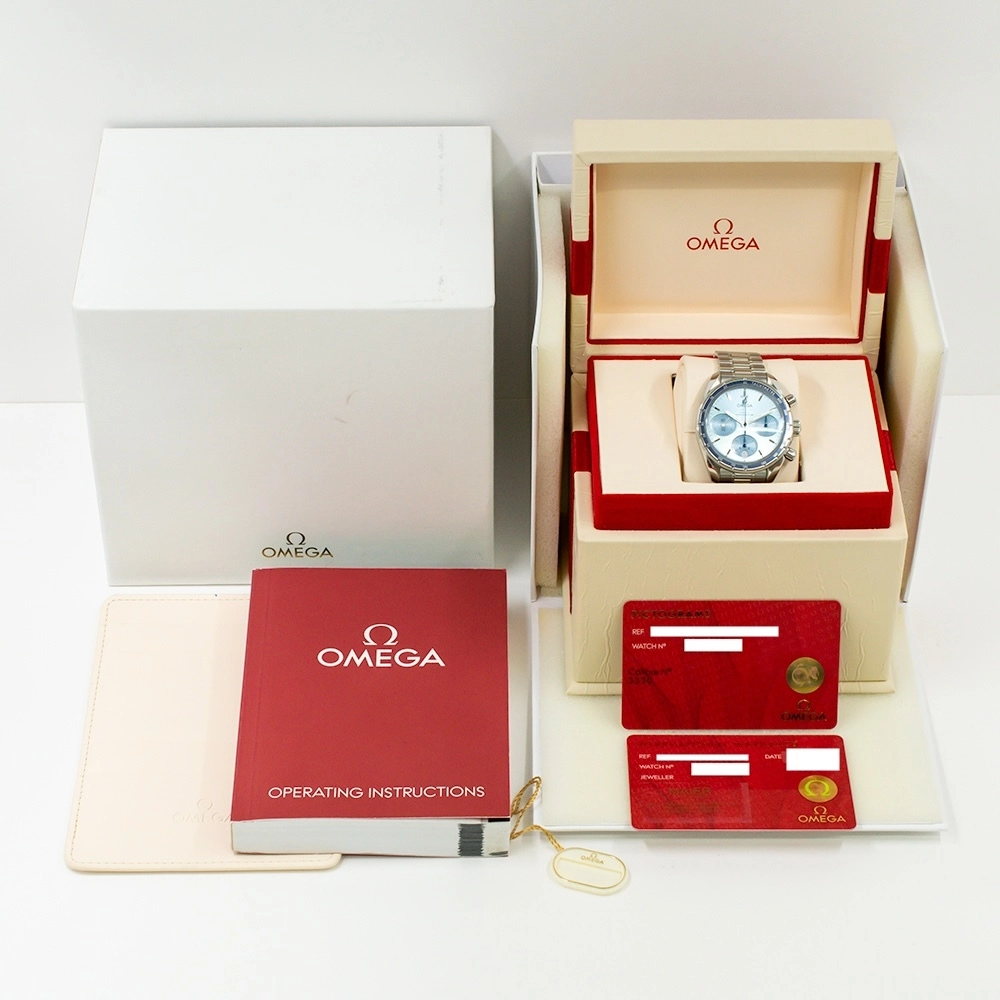
- Box and papers. A full set with the warranty card adds real value on modern references and is close to mandatory on limited editions.
- Service history. Documented service from Omega or a qualified shop means the next owner is not budgeting for an overhaul right away.
- Case condition. Sharp bevels on the lugs are what collectors look for. A heavily polished case with soft edges is worth less, full stop.
- Bracelet vs strap. A modern Moonwatch on its original bracelet is worth a few hundred more than the strap version, and vintage bracelets are collectible on their own.
- Originality on vintage. Original dial, hands, bezel and pushers carry most of the value on a 145.022 or anything older.
If you are unsure how an old watch you own stacks up, a professional watch appraisal is the fastest way to find out before you list it or insure it.
Vintage Speedmaster Fakes and Franken Watches
Outright fake Moonwatches exist, but the bigger risk on vintage is the franken watch. That is a real Speedmaster assembled from parts of different eras or fitted with service replacement components that do not belong on that reference. The watch is genuine Omega, so it passes a quick look. It is simply worth a fraction of an all-original example.
Service parts are the usual culprit. For decades Omega replaced worn dials, hands and bezels during routine service, and those parts look close to the originals without matching them. The bezel alone can swing a vintage price by thousands. Early bezels with the dot over the 90 marker (collectors call it the DON bezel) are far more desirable than later dot next to 90 versions, and swapped bezels are common.
Before you pay vintage money, get the watch opened and checked. Our watch authentication service looks at the movement, caseback and dial against the reference, and our vintage watch verification guide explains what an honest seller should be willing to show you. Anyone selling a cal 321 Speedmaster who will not open the caseback is telling you something.
What to Check on a Modern Moonwatch
Modern Speedmasters are far less risky than vintage, but a few checks still separate a good buy from a headache. Start the chronograph, let it run for a minute, stop it and reset it. The seconds hand should start cleanly, the minute counter should jump on time, and the reset should snap every hand back to zero. A hand that stops short of zero or a stiff pusher points to service coming soon.
Wind the crown and feel for smooth, even resistance. Grit or slipping means the keyless works need attention. Look at the bracelet from the side for stretch between the links, and check the clasp for play. On a sapphire sandwich, look through the caseback for dust or tool marks on the movement, which tell you someone without the right tools has been inside.
Finally, match the paperwork to the watch. The serial on the warranty card should match the case, and the purchase date tells you whether any of the factory warranty remains. A seller who cannot explain a missing card or a mismatched number is the seller to walk away from.
Speedmaster vs Rolex Daytona on the Resale Market
The Speedmaster and the Daytona are the two chronographs every collector ends up comparing, and their resale behavior could not be more different. A steel Daytona has spent years trading near or above retail, while a modern Moonwatch reliably trades well under it. That makes the Speedmaster the value play for a buyer and a slower asset for a seller. Our full breakdown of Omega vs Rolex covers how the two brands compare on build, service and long-term value.
Retail vs What to Actually Pay
Here is the plain math for fall 2026. A new 3861 hesalite on the bracelet is $7,800 at retail. A lightly worn one with box and papers usually changes hands for $5,500 to $5,800. That is roughly a 25 to 30 percent saving for a watch that looks and runs the same, with most of its life ahead of it.
Sapphire sandwich versions run $9,000 and up new, against $5,500 to $6,800 pre-owned. The saving is even larger. The only modern Moonwatches where buying new makes more sense are the brand-new releases, where the used market has not caught up yet, and even there we would wait a year.
If you have a specific reference in mind and do not see it in stock, use our request a watch form and we will source it.
Service and Care in South Florida
A Moonwatch is rated to 50 meters and does not have a screw-down crown. It will handle rain, sweat and a splash at the sink. It is not a pool watch and not a boat watch, and it should never go in the ocean off Palm Beach. Never press the chronograph pushers underwater, because that opens a path for water straight into the case. If you want a watch for the boat, a Seamaster is the right tool.
Salt air and humidity are hard on gaskets, so have water resistance tested regularly if you live on the coast. Wind the watch at the same time each day, and stop when you feel resistance. For routine care and service intervals, see our guide to Omega annual maintenance. The 1861 is simple and inexpensive to overhaul. The 3861 Co-Axial costs more to service but is built to run longer between visits. Hesalite scratches can be buffed out at any service.
Buying or Selling an Omega Speedmaster in West Palm Beach
WPB Watch Co. is an independent pre-owned dealer at 1601 Forum Place in West Palm Beach, a short drive from Worth Avenue. We buy, sell, trade, authenticate and service Speedmasters, from 1861 daily wearers to vintage 145.022s. Every watch we sell is inspected by our watchmakers before it goes on the site.
Selling? Get a real number through our sell your watch page, or read how to trade up to a different luxury watch if you want to put your Speedmaster toward something else. Buyers can browse our full Omega inventory online or come in and try on a few Moonwatches side by side.
Omega Speedmaster FAQ
How much is an Omega Speedmaster in 2026?
A new 3861 Moonwatch with the hesalite crystal lists at $7,800 on the bracelet. Pre-owned, the same watch trades from $4,400 to $5,800 in good to excellent condition, and 1861-era Moonwatches start around $3,500.
Is the Omega Speedmaster a good investment?
Modern Moonwatches trade below retail, so they are a value buy, not an investment. Vintage cal 321 references and the stronger limited editions have held and grown their value, but condition and originality decide everything.
Should I buy the Speedmaster 3861 or 1861?
Buy the 3861 if you want the best movement, bracelet and finishing Omega has put in a Moonwatch. Buy the 1861 if you want the classic Moonwatch experience for about $1,000 less.
Is hesalite or sapphire better on a Speedmaster?
Hesalite is the original flight-spec crystal and polishes easily when it scratches. Sapphire resists scratches and shows the movement through a display back. Both hold value well, so choose on looks and how hard you wear it.
Can I swim with an Omega Speedmaster?
We would not. The Moonwatch is rated to 50 meters with a push-in crown, and the pushers must never be used underwater. For swimming and boating in South Florida, a Seamaster is the better choice.
How often does a Speedmaster need service?
Omega’s general guidance is every several years depending on wear, and Master Chronometer models carry a longer warranty. Humidity and salt exposure are good reasons to have water resistance checked more often.
What is the most valuable Omega Speedmaster?
The original CK2915 from 1957 sits at the top, trading from $50,000 to well above $80,000 for correct examples. Apollo-era cal 321 references and rare limited editions follow.
Ready to find yours? Shop our current Speedmaster collection or browse every pre-owned Moonwatch we have in stock.
Need Help with Sales or Service?